

The supply handshake was a routine Forid had performed for every *Censig* arrival in eleven years.
Cargo manifest on screen. Inventory codes matched against station requirements. Confirm quantities, flag discrepancies, authorize transfer. The station’s terminal was old enough that the display flickered when scrolling, a rhythmic pulse he had stopped noticing years ago.
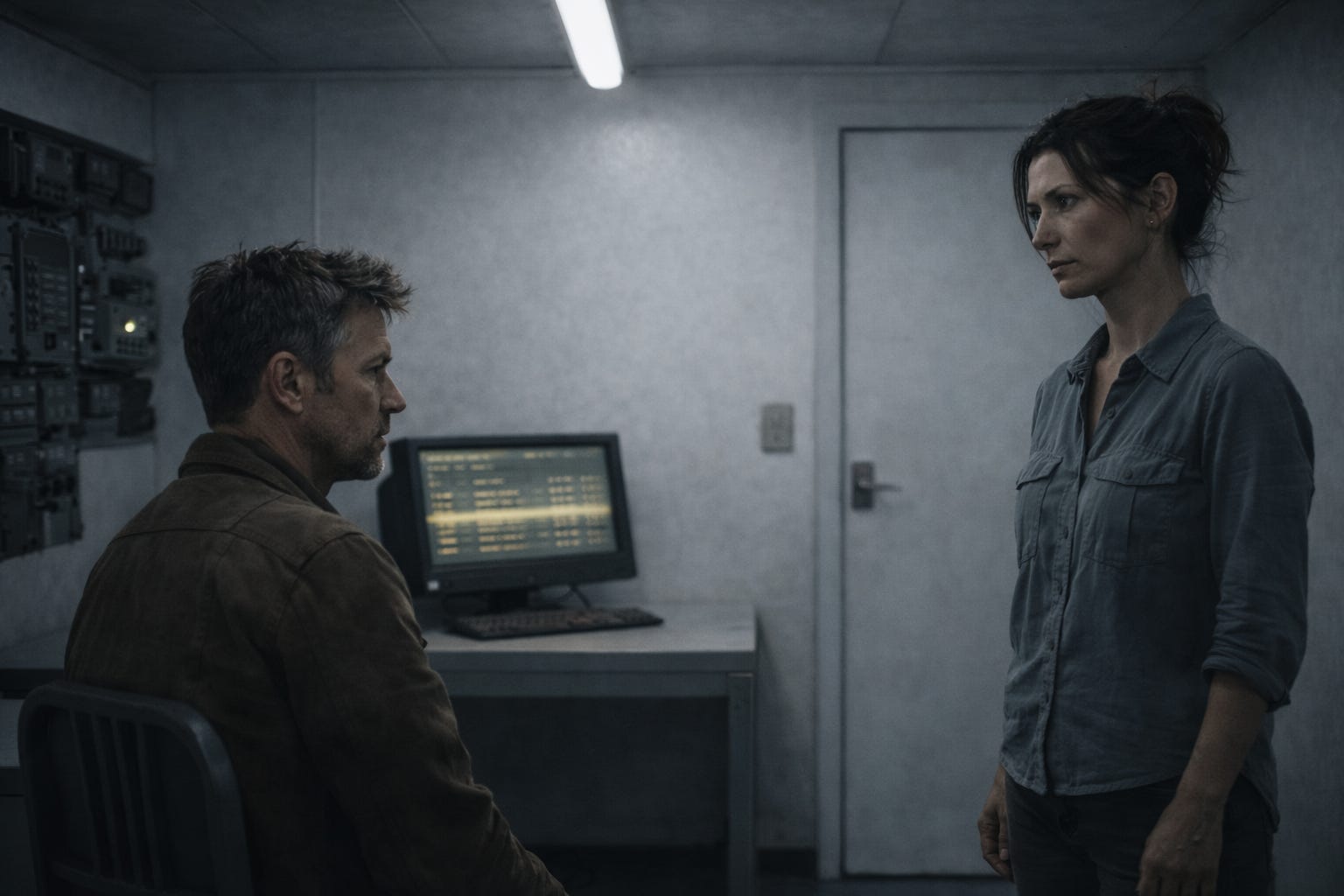
The room was small. Signal relay equipment lined one wall — receivers, processors, a logging unit that archived everything passing through Tresil’s sector and forwarded it to the next node. The surfaces were clean but worn. No decoration. The overhead light was steady and white and had been the same steady white for eleven years. It was a room built for function, and it had been loyal to that function long after anyone remembered why.
He heard the outer door.
Not crew. Crew moved through the station without sound — four people in a space meant for twelve had learned where every hinge protested and avoided it. This was someone who did not know which hinges to avoid.
She came through the interior doorway and stopped.
The room was not large enough for stopping to be invisible. In the corridor, in the landing platform’s open ground, stopping was just a pause. Here, three meters from the terminal where he sat, stopping was a statement.
She looked at the room the way she had looked at the sky — taking it in before deciding what to do with it.
“Supply handshake,” she said. “I was told this is where it happens.”
It was not true in the way she meant it. Sub-division heads did not perform supply handshakes. Crew chiefs did, or logistics officers, or — on a station like Tresil — whoever was there. She had no reason to be here except that she had walked this direction and no one had stopped her.
“It does,” he said.
He did not ask why she had come. On Tresil, people arrived at the signal room for reasons they could not always name. Eleven years had taught him that the reasons usually became clear if you did not force them.
She stepped closer to the terminal. Not to him — to the screen. The cargo manifest was still scrolling, its rhythmic flicker casting a faint pulse across her face.
“How many ships come through here?”
“Three a year. Sometimes four.”
“And between them?”
“The signal relay. Tresil processes and forwards. Everything that passes through this sector goes through that wall.” He indicated the equipment without turning. “We’re an archive that doesn’t know it’s an archive.”
Something shifted in her expression. He could not have named it — it was not recognition, not surprise, not the careful blankness he had seen on the platform. It was closer to the thing that happens when you hear a word you have been thinking but have not said aloud.
She looked at the relay equipment. Receivers, processors, the logging unit with its steady indicator light. Data flowing through a station that did not evaluate what it carried. A vessel that moved everything at equal weight.
“What do you do with discrepancies?” she asked.
“Flag them. Report upstream. Usually it’s quantities — someone miscounted rations, or a replacement part was listed twice.” He paused. “Sometimes it’s a classification. Something arrives that doesn’t match any category the station knows. The system flags it as unresolved and waits.”
“Waits for what?”
“For someone to come through who understands what it is.”
He said it the way he said everything — evenly, without weight. The observation of someone who had spent eleven years watching things arrive and learning not to rush toward them. He did not know that the word *unresolved* had landed in her like a stone in still water.
She was quiet for a long time. The terminal flickered. The relay equipment hummed its low continuous note. Outside, the crew from *Censig* was completing standard planetfall procedures — she could hear the distant efficiency of people doing what they were designed to do.
“The ground here holds water,” she said.
It was not a question about hydrology. He understood this the way he understood weather — not through analysis but through years of standing in it.
“Mineral density,” he said. “The original survey noted it. No one since has found it worth mentioning.”
“You found it worth mentioning.”
“I found it worth noticing. Mentioning is what’s happening now.”
She almost smiled. He saw it — not the smile itself but the moment before, the shift in the muscles around her eyes that meant something had moved from one place to another inside her. It lasted less than a second. Then she was looking at the screen again.
The cargo manifest had reached Packet 31.
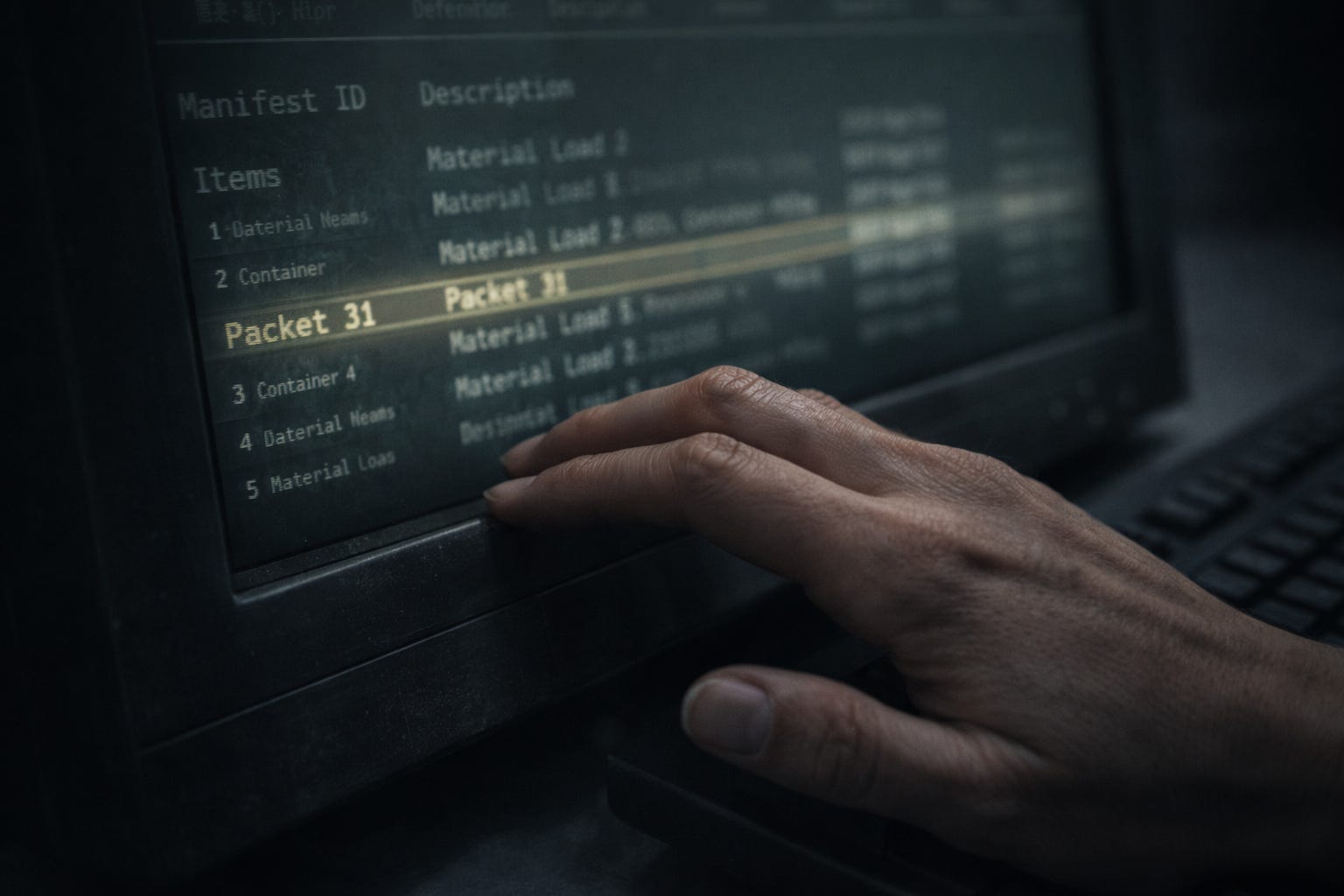
She saw it the way you see your own name in a crowd — involuntary, immediate, total. The line item sat between navigational updates and agricultural data, classified as speculative mathematics, flagged for standard distribution. Moderate value. Long-cycle asset.
Her hand moved to the terminal edge. The sharp edge. Her fingers found it and ran along its length, the gesture so automatic that she did not realize she was doing it until she felt the surface — different from her terminal on Deck Seven. Smoother. Older. Worn down by years of other hands.
She pulled her hand back.
“Thank you for the walkthrough,” she said.
“The handshake isn’t finished.”
“I know.”
She looked at him for the first time directly. Not as a signal from forty meters, not as a presence in peripheral vision — but close, in the steady white light that hid nothing. His face was weathered in a way that had nothing to do with age. Lined from squinting at horizons. Patient eyes directed outward, always toward what was arriving.
He looked back. The woman he had seen on the platform — angular, sharp, carrying something invisible — was the same woman standing here. But closer, the sharpness was not armor. It was compression. Everything she carried pressed into a smaller and smaller space until the edges cut.
Neither of them moved.
“I’ll come back for the handshake,” she said.
“The station isn’t going anywhere.”
She turned and walked back through the doorway. He listened to her footsteps — she had already learned one of the hinges. The outer door opened and closed with only a small protest.
Forid sat in the steady light and looked at the manifest still on screen. Packet 31. Speculative mathematics. He had read the preview twice without finishing and had not known why.
He still did not know why. But the shape of not-knowing had changed. It was no longer a gap. It was a space where something was beginning to grow — slowly, the way the ground outside held water, the way mineral density meant things lasted longer than they should.
He went back to the cargo manifest and continued the handshake alone.