
The ship was humming again.
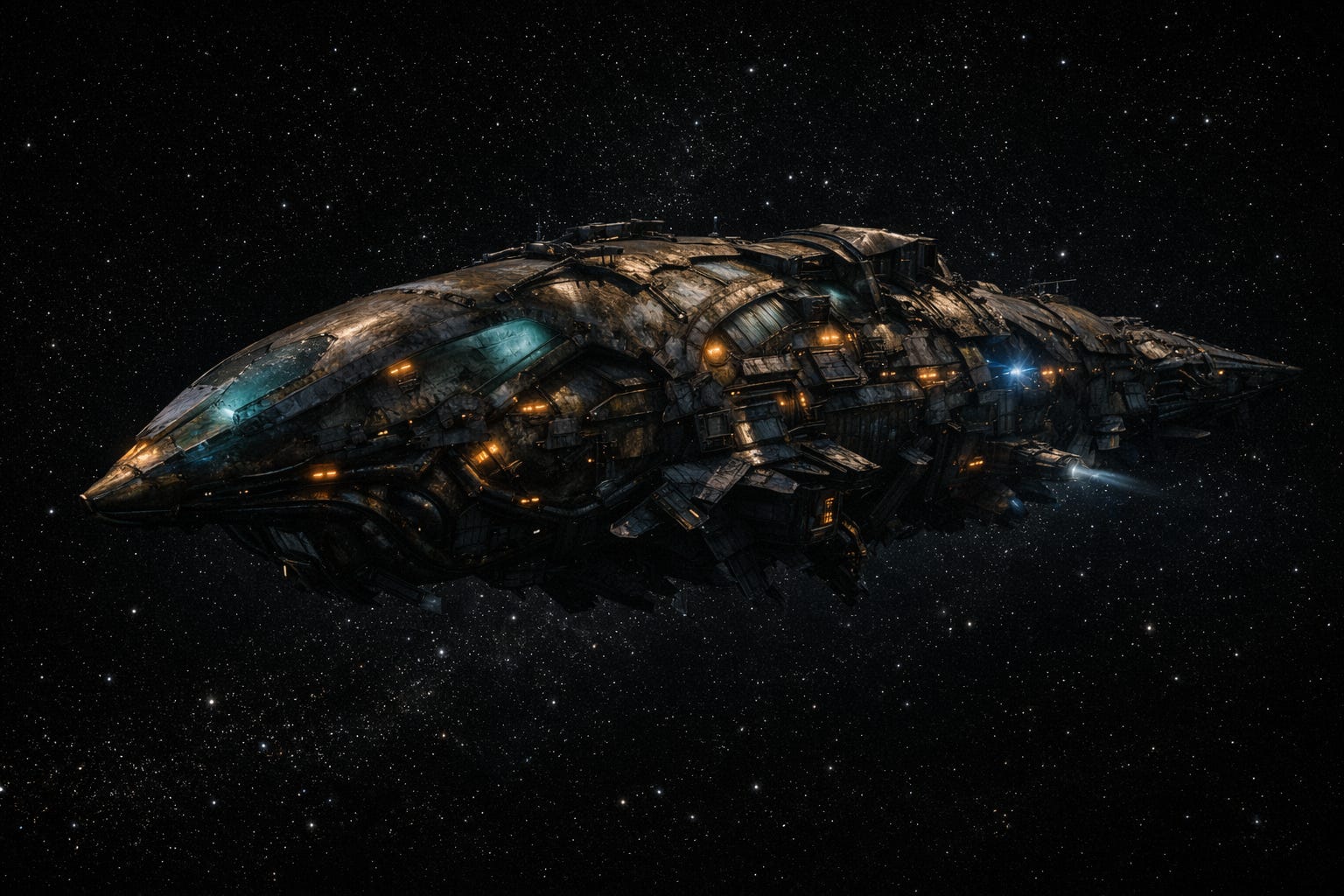
Kess Farec sat sideways in the captain’s chair — a structure no human hand had designed, its curves following a geometry her body had learned over three years of sleeping, eating, and making decisions in it. The armrests were too wide. The angle assumed a torso longer than hers. She had fixed this with a folded jacket and the particular stubbornness of someone who had stolen a ship and refused to admit it didn’t fit.
The walls glowed. Slow shifts of amber and blue-green that tracked no pattern she had ever been able to map. The ship’s original builders had woven illumination into the hull itself. No fixtures, no switches, no wires. The light was the ship’s skin, and the skin was alive, and Kess had spent three years pretending this did not unsettle her.
It unsettled her.
She tapped the nearest wall with her knuckles — two short, one long, the way you knock on a door you know won’t open. “I know you’re listening,” she said. The light did not respond. It never did when she spoke to it directly. Only when she forgot it was there.
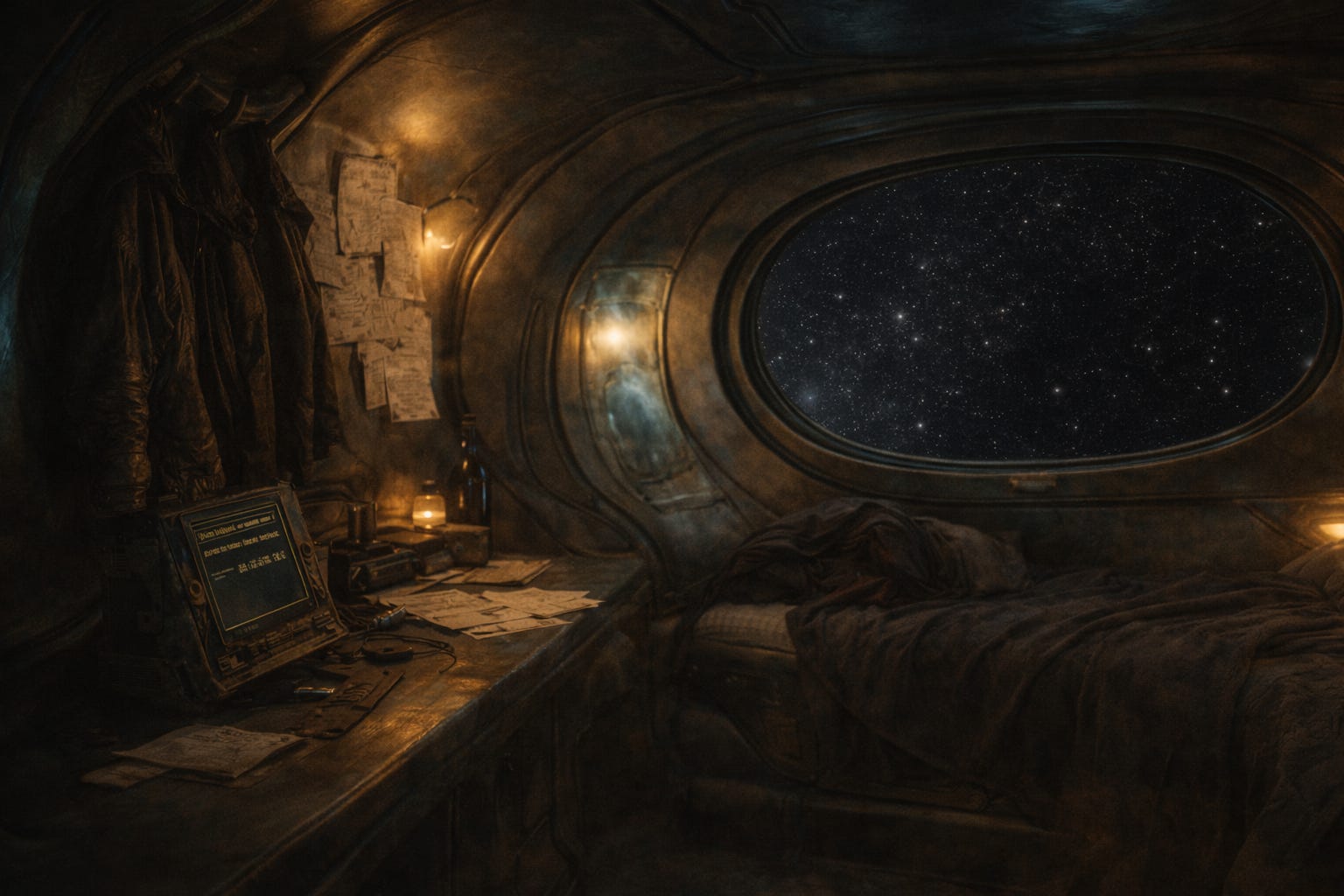
The cabin was small — smaller than it should have been on a vessel this size. She had chosen it over the larger quarters two decks up because this room had a viewport, and the viewport was oval, and through it she could see stars without the ship’s architecture interpreting them for her. The viewport was raw. Unprocessed starlight. She needed that.
Star charts covered the wall to her left — pinned with adhesive tape over surfaces that probably responded to touch, if she had known the right gestures. A bottle sat on the console, half-empty, next to a navigation tool she had taken from a Chilin relay station two years ago. Blankets on the narrow bunk. Three jackets — two leather, one thermal — hanging from a structural rib the builders had never intended as a hook.
The distribution notification had arrived forty minutes ago.
Packet 31. Speculative mathematics. Moderate value. Long-cycle asset.
*A system that reaches the point of improving its own structure without outside input.*
Kess smiled. The smile she used on port officials and reluctant fences and anyone who needed to believe she was less dangerous than she was. She used it now, alone, because the habit was older than the strategy.
“There you are,” she said to the screen.

She closed her eyes. The ship hummed beneath her. The light shifted — a long, slow pulse of amber that crossed the ceiling and faded into the blue-green of the walls. The ship did this when she was still for too long, as if checking whether she was asleep or dead or simply thinking. She had never determined which.
---
Seven months ago, on a station she would not return to, a man had told her a story.
He was old — older than anyone she had met in the relay network. He sat in a trading post on the station’s lower level, surrounded by objects he was not selling, and he spoke to her because she had asked a question no one else in the room would have thought to ask.
She had asked: “What’s the most expensive thing Chilin has ever sold?”
“Nothing,” he said. “The most expensive thing they’ve handled, they haven’t sold yet. They don’t know they have it.”
She had sat down. Not because he invited her — because her legs made the decision before her mind caught up.
He told her enough to understand what it was. Not enough to understand what it meant. He spoke in fragments, pulling pieces from a shelf he had stopped organizing long ago. She filled the gaps herself. That was what made it stick — she had to build the shape from what he left unsaid.
“And the ones who do understand?” she had asked.
“They will try to own it.”
She had been standing at the door, already calculating, when he spoke again.
“I’m not afraid,” she said.
He had looked at her with the patience of someone who had heard this before. “That,” he said, “is what frightens me.”
The false identity had taken four months to build. The documentation was simple — Kess had built phantom civilizations before. The hard part was the patience. Four months of being a client. Buying eleven packets she would never read. Responding with purchase patterns that kept her invisible. Paid for with currency constructed from nothing — but constructed so carefully that the nothing held weight.
Eleven packets. Four months. And now Packet 31 sat in her queue, authorized by a representative who was currently lying sideways in a stolen chair on a stolen ship in a stretch of space that no one was watching.
She opened her eyes.
Forty-seven buyers. She had built her profile near the bottom of the list — mid-development, resource-limited, ambitious. The civilizations at the bottom received their packets last, which meant time. Time to see who moved first.
She intended to move before any of them.
---
The ship hummed. The light pulsed. Outside, stars moved at distances that meant nothing and everything.
Kess Farec placed the order.
The system confirmed: Packet 31, speculative mathematics, moderate value. Delivery via standard relay chain. Estimated arrival: eleven days.
She closed the console and sat in the living light of a ship that was not hers, in a room she had made her own, and waited.
The ship’s hum shifted — a quarter-tone lower, settling into a frequency she had not heard before. Patient. As if the ship, too, was waiting.
She did not notice. She was already calculating.