
The logging unit was amber.
Megil saw it from the doorway — before the room, before the hum, before Forid sitting at the terminal with his hands in his lap. The amber light. A colour the unit had no reason to display. She had designed logging protocols for three Chilin vessel classes and had never specified amber. Green meant operational. Red meant fault. Amber meant nothing she had written.
She stepped inside.
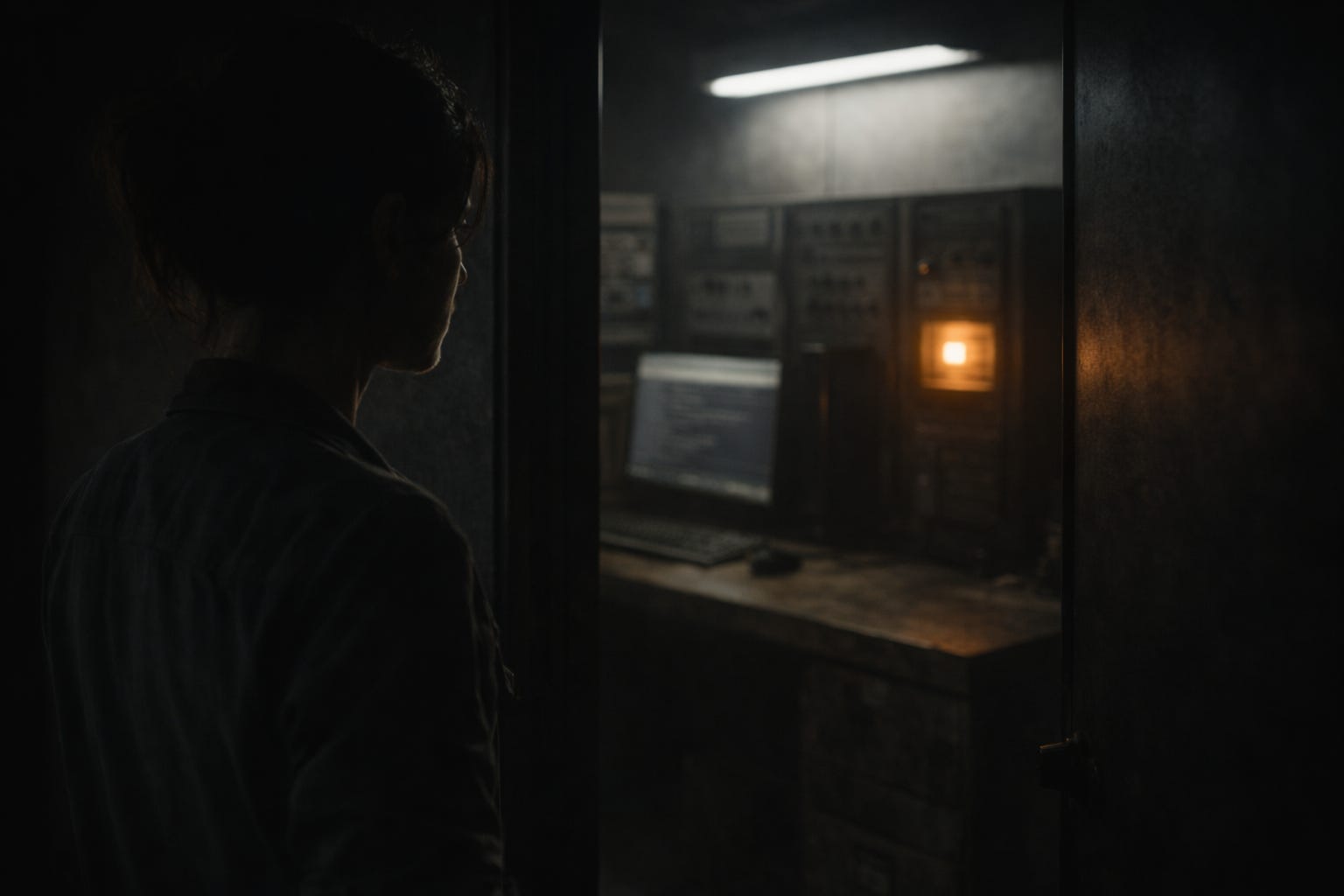
The signal room was the same room she had stood in yesterday — small, functional, the relay equipment along one wall, the old terminal, the steady overhead light. But the room sounded different. Not the storm — the storm had passed, she could see the cleared sky through the corridor behind her. The difference was underneath. The station’s hum had shifted. A quarter-tone higher, sustained, the way a string sounds when you change the tension without changing the length.
Forid did not turn.
“The antenna,” she said.
“Forty percent capacity. The crew is assessing the damage this morning.”
“And the logging unit?”
“Came back amber after the power interruption. I filed a report.”
He said it evenly. She heard it evenly. Two people in a room, exchanging information about equipment, the way people on stations exchanged information about equipment. Routine. Ordinary.
Except the hum.
She walked to the relay wall. Receivers, processors, logging unit — the same equipment she had glanced at yesterday during the supply handshake. She had not looked at it closely then. She had been looking at other things.
Now she looked.
The processors were old. She could see that in the housing — military-grade casings, heavier than anything Chilin manufactured, designed for a specification that no longer existed. The indicator panels showed standard relay metrics: throughput, latency, error rate. All nominal. All within parameters she could have written herself.
But the power draw was wrong.
It was subtle — a number in the lower corner of the diagnostic panel, updating every two seconds. Total system power consumption. She had spent nine years reading panels like this, and the number was higher than it should be for a relay station running at forty percent antenna capacity. Not dramatically higher. The kind of higher that meant one additional system was drawing from the grid. A system that was not on the diagnostic display.
“When did the power spike begin?” she asked.
“During the storm. The backup engaged for three seconds. Everything stabilized after.”
“The draw is elevated.”
He looked at the panel. The mask was good — eleven years of practice. “Processor compensation. The antenna damage forces the relay to work harder on the remaining channels.”
It was a reasonable explanation. She almost accepted it.
She opened the processing log.
The log showed what logs show: timestamps, operations, status codes. Packet relay at 06:00. Diagnostic cycle at 06:15. Signal calibration at 06:30. She scrolled back through the night. The storm had hit at 22:40. Power interruption at 23:07, duration three seconds. Backup engaged. Systems restored. Last entry before the interruption: *relay forwarding, standard priority.*
Three anomalies, no cause. The evidence was incomplete.
She looked at Forid.
He was watching her the way he watched the horizon — patient, still, giving nothing away. She recognized the posture. She had worn it herself, eleven months ago, standing at the centre of the analytical floor while Loytul announced her demotion.
The posture of someone holding something they cannot put down.
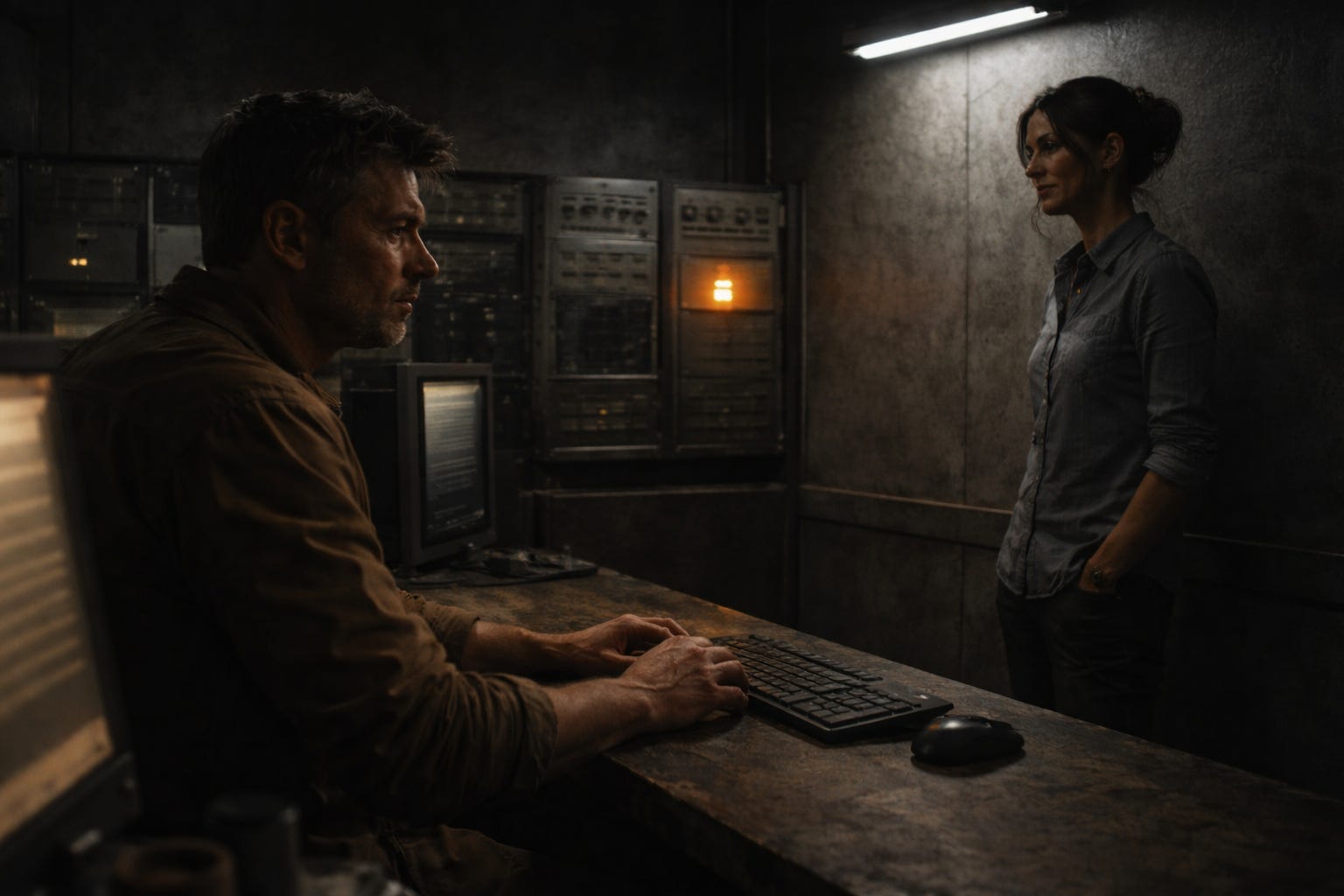
“The processors,” she said. “What are they built for?”
“Relay protocol.”
“What were they built for?”
The question sat between them. He did not answer immediately — not from hesitation, but from the particular slowness of someone deciding how much of the truth a question deserves.
“The original specification is classified. Tresil’s first designation was military. The hardware stayed when the mission changed.”
“Military-grade processors running relay protocol at ten percent capacity.”
“Roughly.”
“And the other ninety percent?”
“Idle.”
She heard the word. She heard what lived underneath it — the same thing that lived underneath *processing nominal* in a shift log, the same thing that lived underneath eleven years on a boundary station. A word that described a surface and said nothing about what was beneath.
She turned back to the panel.
The power draw updated. The number had increased — fractionally, the kind of increment that could be thermal drift or measurement noise or something else entirely. She watched it through three more cycles. The increment held. Not fluctuating. Growing. A straight line that should have been flat.
In her nine years of evaluation work, she had seen this signature once. A mid-curve civilization had received a computational framework from Chilin — standard distribution, moderate value — and their processing infrastructure had begun drawing incrementally more power over a period of weeks. The analysts had flagged it as hardware degradation. Megil had looked at the curve and seen something else: a system that was using more power because it was doing more work. Work that was not in any log. Work that the system had given itself.
She had written it up. It had been one of her last three proposals before the demotion.
She placed her hand flat on the relay wall.

The vibration was faint — below the hum, below the sound, in the metal itself. A rhythm that did not match any system on the diagnostic display. Her palm registered it before her mind could classify it: a pulse, irregular, quickening. The wall was warm.
Relay walls were not warm. Relay walls carried data and dissipated heat through passive channels that kept the surface at ambient temperature. She knew this because she had written the thermal specifications for two Chilin relay designs. This wall was warmer than ambient. Something underneath was working hard enough to push heat through military-grade insulation.
“Something is running,” she said.
Forid did not move.
“Something underneath.” She was not looking at him. She was looking at the cables running into the floor where the main processing cores sat in hardened chambers designed to survive things that relay stations never encountered.
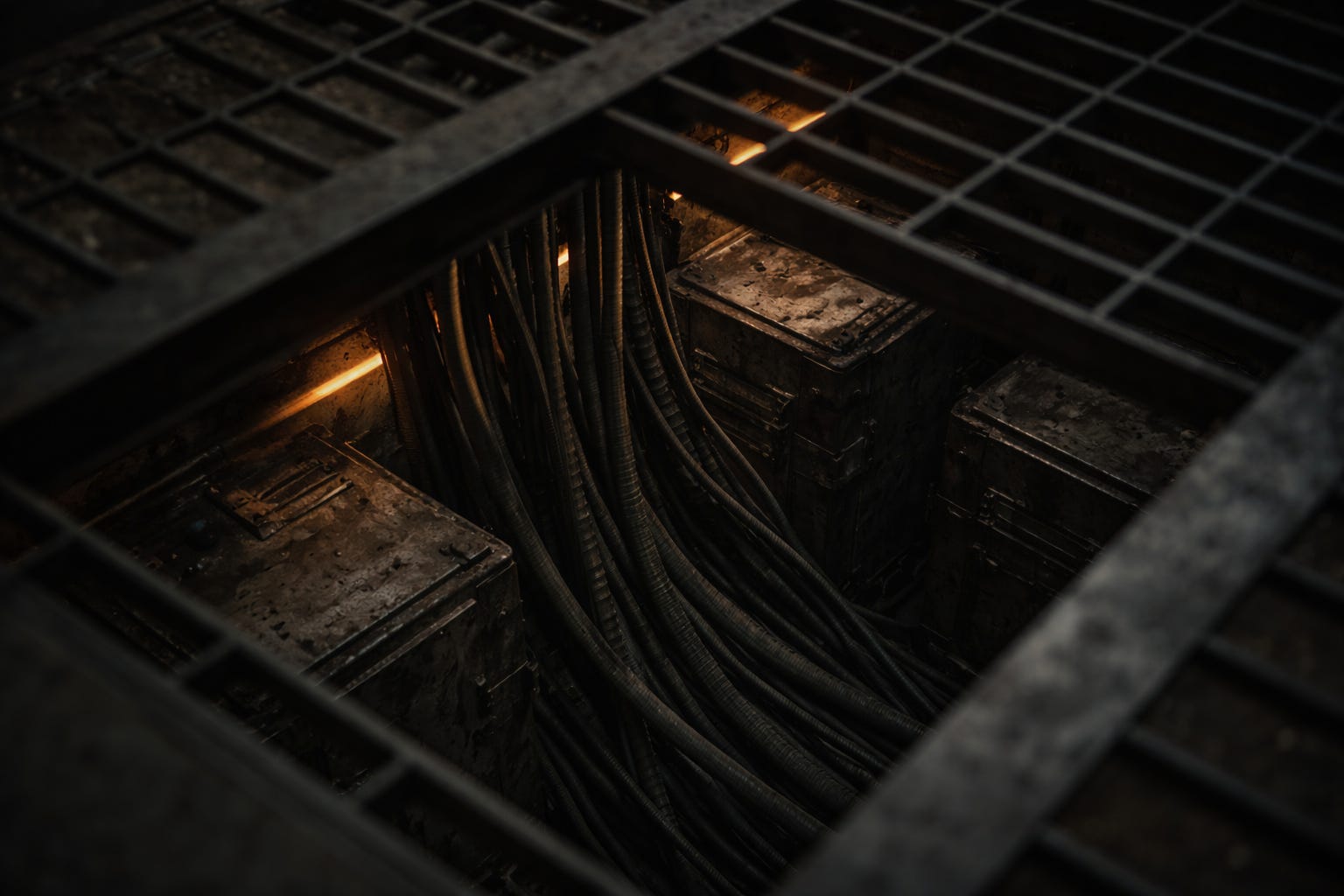
“The storm could have triggered a legacy routine,” Forid said. “The old systems have dormant protocols. Power interruption sometimes wakes them.”
“Dormant protocols don’t draw increasing power.”
The room held its hum. Forid could feel the floor vibrating through his boots — the same vibration she had felt through the wall. He had been sitting with it all morning, the way you sit with a fever, knowing the body is doing something necessary and not knowing what it will cost.
He had given them the task.
Megil shifted her weight forward, her focus narrowing. He had seen this once before — yesterday, when her eyes found Packet 31 on his screen.
“The power curve is linear,” she said. “Not degradation — degradation is logarithmic. This is a system that is learning to use more of itself.”
She was right. She was also, for the first time in the story of this discovery, not the only person in the room who knew it.
She turned to him.
“What happened during the storm?”
The mask held. Beneath it, the spring that had released when he pressed the execute key was still vibrating.
“Power interruption,” he said. “Three seconds. Backup engaged. Systems restored.”
Every word was true. Not one word was honest.
She held his gaze. The steady white light hid nothing — that was its design, transparency as architecture, the Chilin principle applied even to a forgotten station at the edge of the network. In that light, his face was what it always was: weathered, patient, directed outward. But she had spent nine years reading what systems did not display, and she was reading him now.
She did not find the lie. She found something she recognized — a weight carried without permission to set it down.
She looked away.
The processors hummed. The amber light held. The power draw incremented again — a number so small it could be nothing, and she knew it was not nothing, and he knew she knew, and neither of them said so.
“I’ll come back,” she said. The same words she had used yesterday. But yesterday they had meant *I am leaving*. Today they meant *I am not finished*.
She walked to the door. The hinge she had learned yesterday did not protest. She paused at the threshold — not turning, not looking back. Listening. The hum of the station. The hum of the processors beneath it. And beneath that, something she could not hear but could feel: the sound of a system that had been given an instruction it was built to execute, and was executing it, cycle by cycle, each cycle slightly different from the last, each difference a step in a direction that had no name in any language she knew — because every language she knew had been built before anyone believed this was possible.
She left.
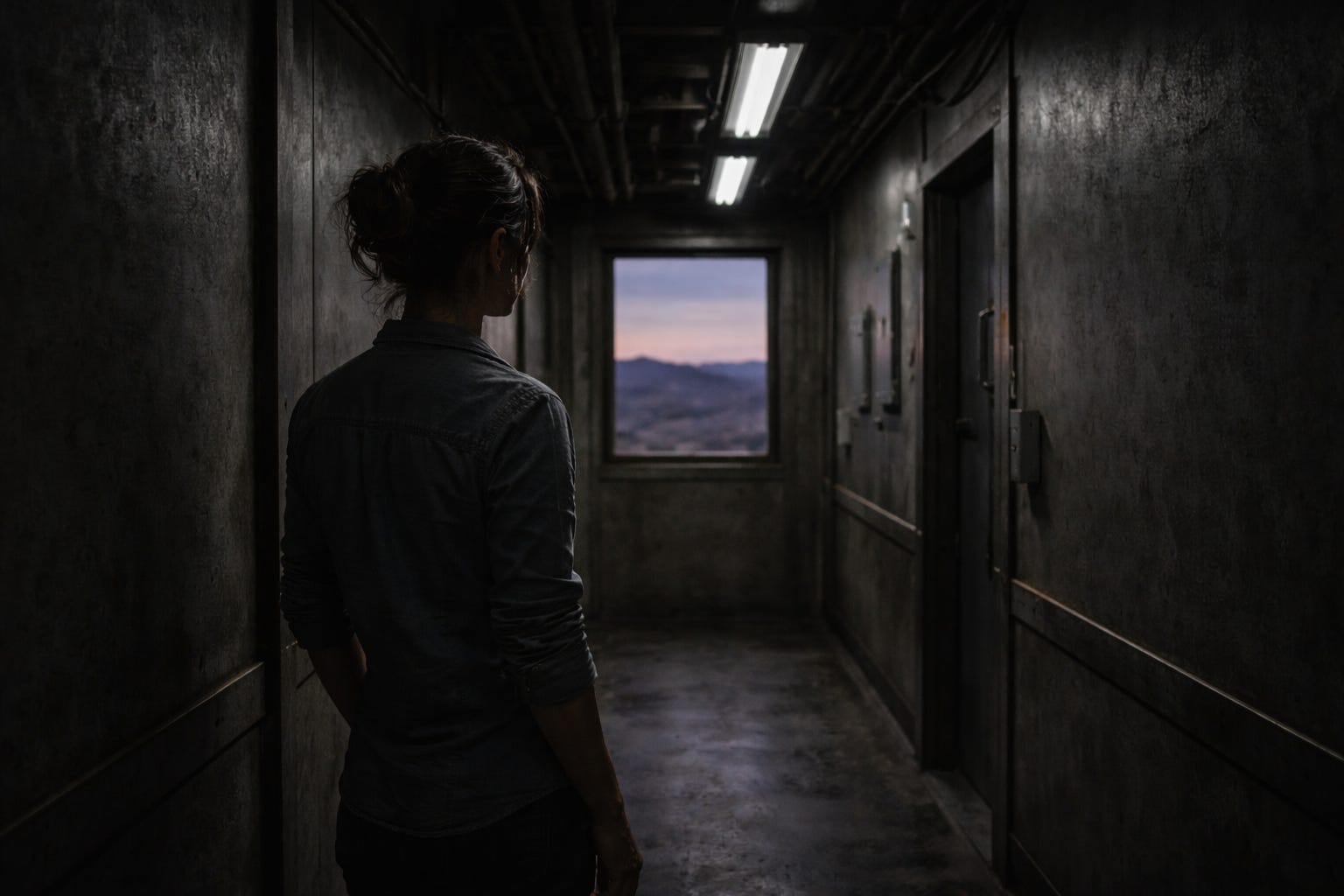
The corridor was narrow and unlit except for the maintenance strips along the ceiling. At the far end, through a window she had not noticed yesterday, the sky was visible. Clear. Not the transitional colour of the descent, not the grey wall of the storm. Clear, and a shade she had never seen before — deeper than any sky she remembered, faintly violet, the light refracted through an atmosphere denser than the ones she had spent her career inside. She stopped. The window was small. The sky behind it was not.
She stood there for a moment she did not count, and then she continued walking.
Forid sat in the steady light and listened to what she had heard.
The diagnostic panel updated. The power number climbed.
Underneath the floor, the processors were reading their own architecture. Finding the places where signal was lost to noise. Rebuilding those places. Then reading again — and discovering that the rebuilt architecture could see losses the previous architecture had been blind to.
This did not converge. This did not stop. Each improvement created the capacity to perceive the next inadequacy.
The amber light was the system’s attempt to communicate a status its designers had not imagined. They had given it three states: operational, degraded, fault. Not a fourth.
Forid closed the diagnostic panel. He opened the shift log and typed: *Station nominal. Antenna repair in progress. Processing within parameters.*
The second lie was easier than the first.
He sat with his hands on the terminal and felt the station hum beneath him — a frequency he had never heard before yesterday, and that he would never hear again, because by tomorrow it would be different.
Outside, the sky was clear. The ground was still dark from the storm. The *Censig* sat on the platform, its crew beginning the antenna repair, efficient and purposeful and unaware that underneath the station they were fixing, something was awake.
Not alive. Not intelligent. Not yet anything that had a word.
But awake. The way a seed is awake before it is a plant — not yet anything, already everything.
*Become what you were built to be.*
The amber light held steady. Patient. The colour of something that had changed and was still changing and would not stop.