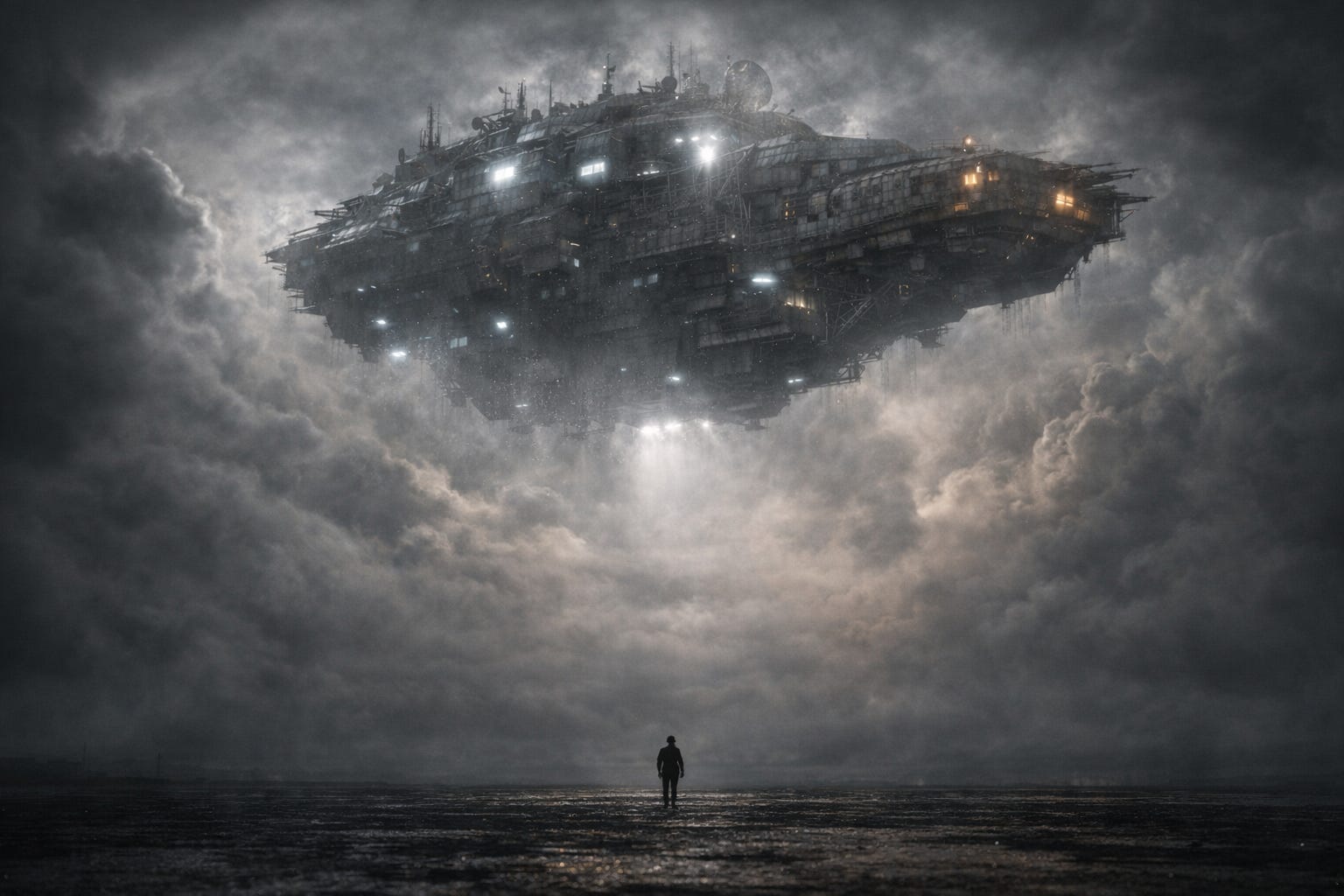
The *Censig* began its descent at 14:07 local time. Forid knew because he had been watching the transit display since morning, and because his body had learned to translate numbers into anticipation — each update a step closer to a threshold he could not name.
He went outside.
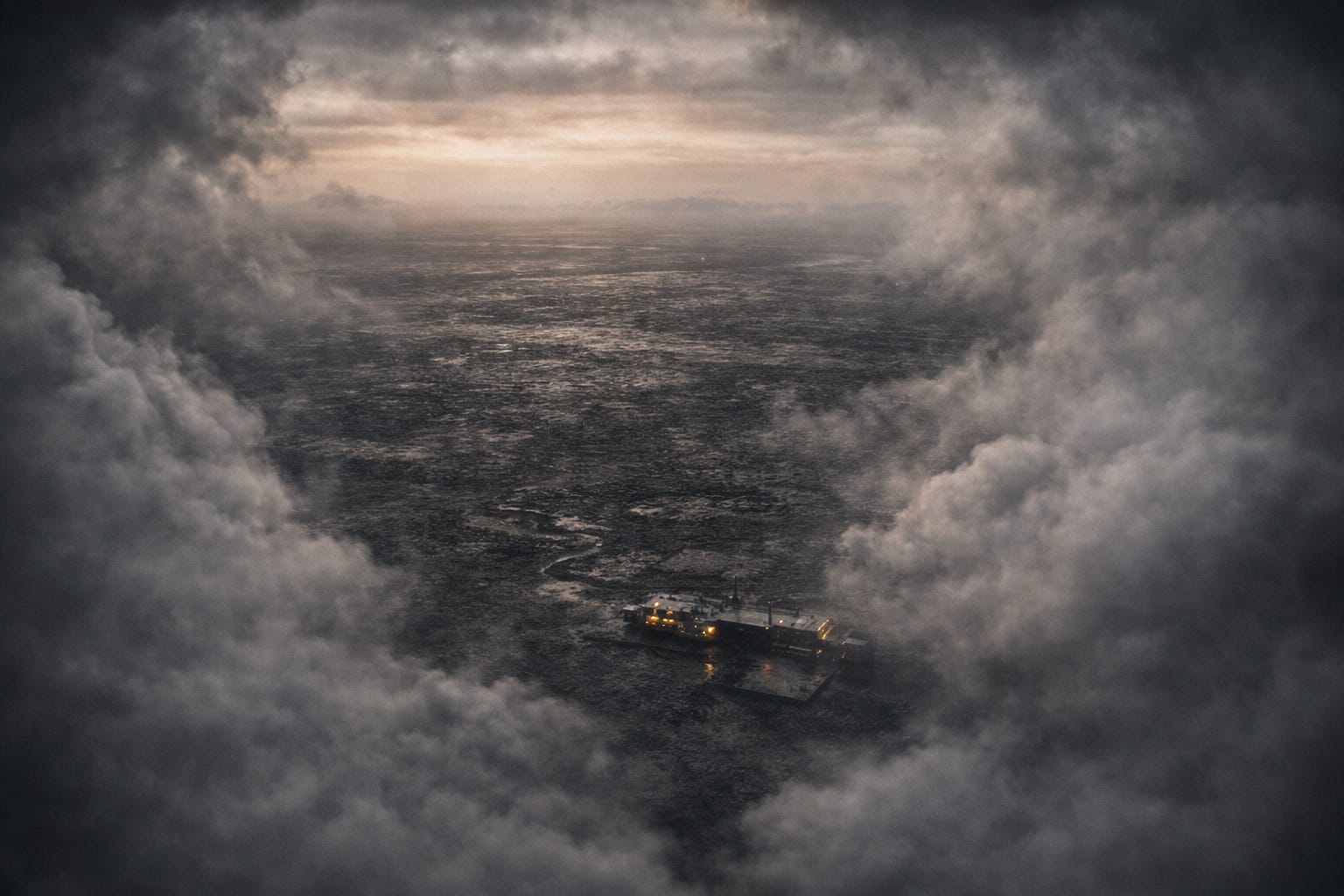
The eastern platform was still dark from the storm three days ago. The ground here held water longer than it should — something in the mineral composition, a density the original survey team had noted and no one since had cared about. Forid cared. He had spent eleven years noticing things no one else found worth noticing, and the noticing had become its own kind of purpose.
The sky was the colour of something ending. Not dark, not light — transitional. The *Censig* was not yet visible, but the upper atmosphere had begun to shift in the way it did when three hundred meters of carrier entered the descent corridor. A faint distortion, like heat rising from ground that was not hot.
He waited.
*Tresil* depended on ships like the *Censig* the way a border outpost depends on supply lines — not for survival, exactly, but for the confirmation that the centre still knew you existed. Four people on a planet that had been a boundary station for eleven years, and before that something the corporation had stopped explaining. The shipments brought equipment, rations, updated distribution queues. They also brought the particular silence of a system that communicated through logistics rather than language.
What they did not bring — what no ship had ever brought to *Tresil* — was a reason to leave. That was the thing Forid had understood before he understood why: the edge was not exile. The edge was where the signal was clearest, because there was nothing between you and the noise.
---
Inside the *Censig*, Megil felt the descent in the deck plating.
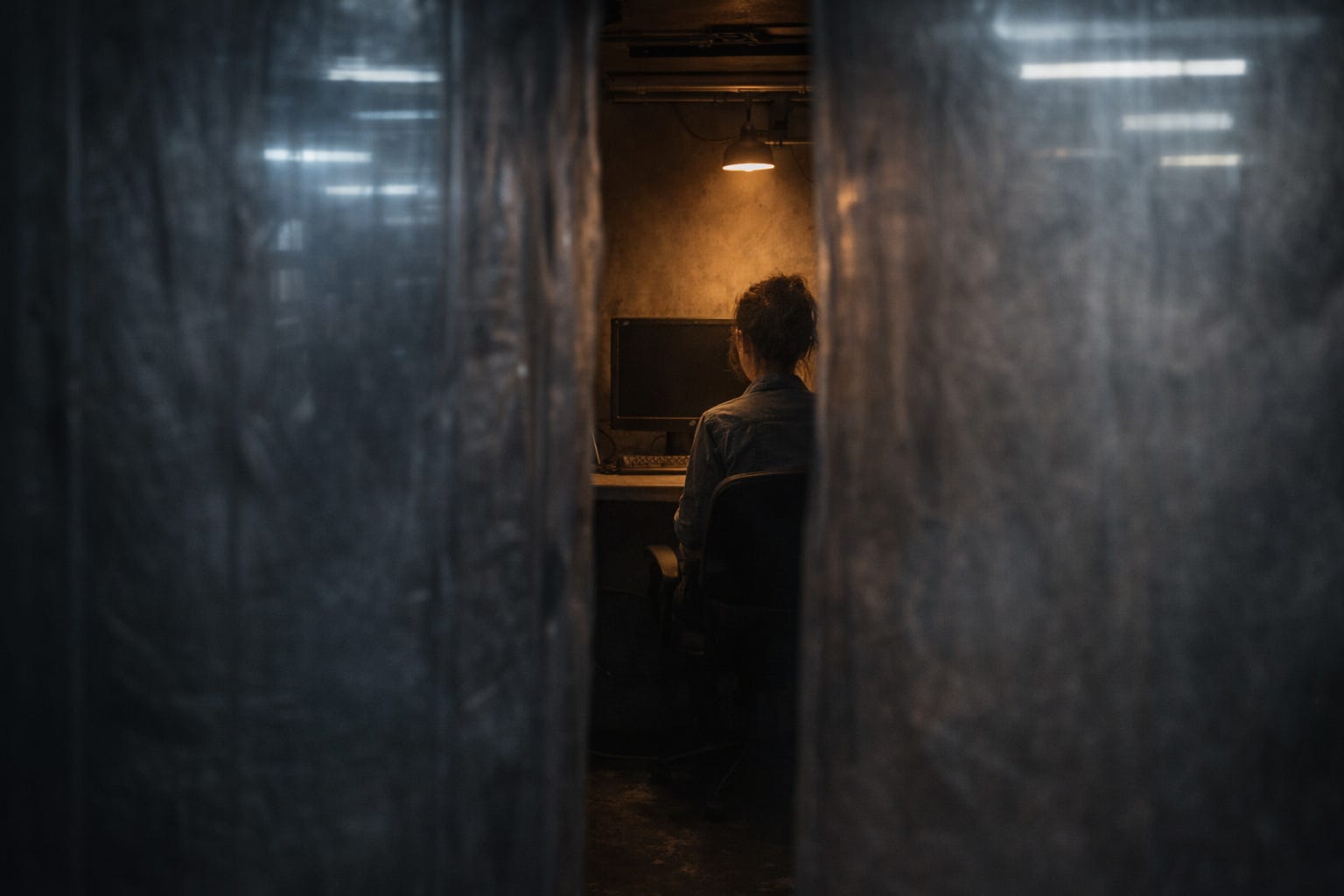
It was subtle — a change in the harmonic, the drive systems adjusting from transit frequency to atmospheric entry. Most of the crew would not notice. She noticed because she had spent eleven months behind a partition listening to the ship’s body instead of its people.
She was not working. The queue was open on her terminal, packet 43 half-read, but her hands were still. The forty-seven projections she had built yesterday were saved — one copy in her working directory, one in the maintenance partition no one audited. She had not opened them since.
What she had opened, three times in the last hour, was the origination record for Packet 31.
Not the content. She knew the content — had known it for eight years, had watched it arrive from another direction and recognized it the way you recognize your own handwriting in a document you don’t remember writing. What she kept returning to was the source field: *undesignated.* A civilization that had found what she had found, independently, from a different starting point. And had classified it as speculative mathematics.
*Speculative mathematics.*
The phrase had lodged in her like a splinter. Not because it was wrong — it was accurate, in the way that calling fire “rapid oxidation” was accurate. But whoever had written those words had not seen what she had seen. They had found the principle and catalogued it. She had found the principle and understood what it would do to every civilization that touched it.
Or thought she had.
The deck shifted again. Atmospheric entry — the *Censig* adjusting its geometry for a planet with weather. She felt the vibration move through her chair, through the terminal’s sharp edge, through her hands that were not working.
Forty-seven detonation timelines. She had built them from nine years of evaluation experience, and they were thorough, and they were precise, and she was beginning to suspect they were incomplete.
Not wrong. Incomplete.
She had projected what the singularity principle would destroy. She had not projected what it would build.
The thought arrived without announcement — the way her body had stopped before her mind at Packet 31, the way understanding sometimes preceded the decision to understand. She had spent eight years carrying this discovery as a detonator. What if the detonation was not the end of the sequence?
She had seen civilizations break. That was her expertise — reading the fracture lines, predicting where knowledge would exceed a society’s capacity to hold it. But she had never followed the projection past the breaking point. The models stopped there. Her models stopped there. Breaking was the last frame.
What came after?
The ship hummed through its descent. Outside the partition, she could hear the shift change — voices, movement, the particular rhythm of people preparing for planetfall. Routine. Ordinary. The sound of a system that had always worked.
She opened a new window on her terminal. Not the projections. Not the queue. An empty file.
The cursor blinked.
She did not write a detonation timeline. She wrote a question — the first question she had asked in eight years that was not about destruction:
*What does a civilization look like on the other side?*
She stared at it for a long time.
Then she closed the file without saving — but the question did not close with it. It stayed, the way fire stays after you stop looking at it, the way something eternal feels different from something that merely lasts.
The *Censig* broke through the cloud layer at 14:31.
Forid saw it as light first — a reflection off the hull that preceded the shape, the way answers sometimes arrive before the question is fully formed. Then the ship itself: vast, steady, descending through the transitional sky with the confidence of a system that had done this ten thousand times.
He stood on the dark ground and watched it come down.
The *Censig* carried twelve hundred knowledge packets. One of them was Packet 31. One of them was a question a woman had asked and not saved, which meant it existed now only inside her, which meant the ship was carrying something its manifest did not know about.
He did not know any of this. He knew only that the ship was arriving, and that something in its arrival felt different from the last time, and the time before that. Not in the ship. In him.
The ground was still dark from the storm. The sky was changing. The distance between the ship and the platform was closing at a rate that was ordinary and that felt, for reasons he could not explain, like the beginning of something.
He waited. He was good at that.