
Eleven months earlier.
The main analytical floor was full. Not unusually — it was always full at this hour, the shift overlap when outgoing analysts briefed incoming ones and the room reached its designed capacity. Forty-two stations, thirty-nine occupied. The light was broad and even, the way Chilin built all its working spaces: nowhere to stand without being seen.
Megil Dys Sin stood at the center of it.
She had not chosen the center. That was where they had asked her to be. Loytul Sak Stor had sent the request that morning — a formal one, routed through the administrative channel rather than spoken, which told her everything the message itself did not.
He was already there when she arrived. Standing, not sitting — a detail she noticed because Loytul always sat. He was a man who trusted furniture. Who trusted rooms, protocols, the weight of a system that had worked for three centuries. She had watched him operate for nine years and had never once seen him reach for something the system did not already provide.
He was not cruel. That was the thing she would need to remember later, when remembering became difficult.
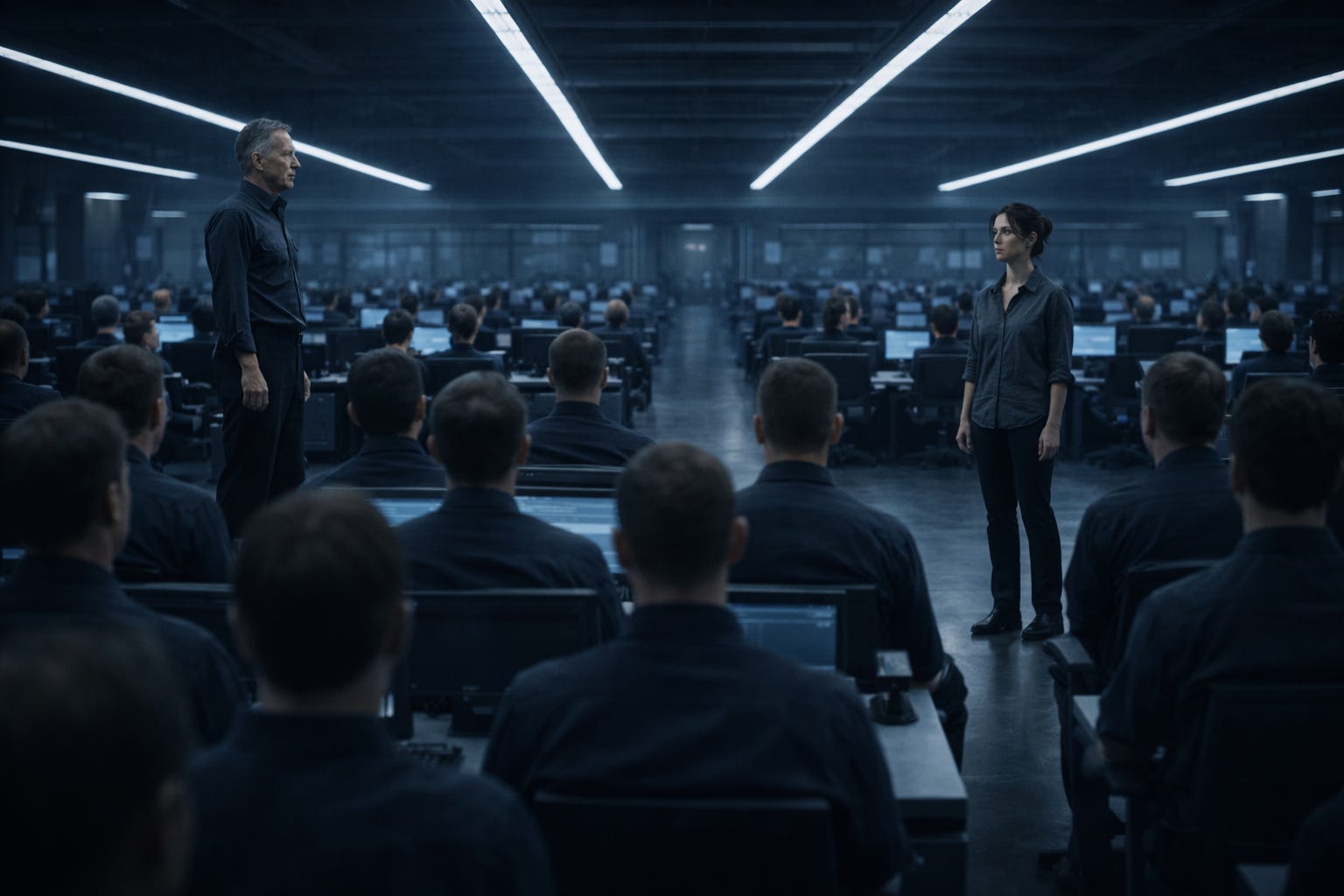
“The assessment division is being restructured,” he said. Not to her — to the room. His voice carried the particular flatness of someone who had rehearsed. “Effective today, the division’s primary evaluation function will be distributed across three existing departments. Oversight will remain centralized.”
She watched the room receive this. Thirty-nine analysts, most of whom had worked under her at some point, absorbing the words with the professional stillness Chilin cultivated in its people. No one looked at her. No one looked away from her. They looked at a middle distance that included her without addressing her.
Community. She had built this community. Trained half of them. Designed the evaluation framework they used every day — the one that determined which knowledge was safe to sell and which required additional assessment. She had given Chilin its conscience, and Chilin had worn it the way it wore everything: efficiently.
“Megil Dys Sin will continue in a reduced capacity,” Loytul said. “Head of sub-division, aft section, Deck Seven.”
Deck Seven. She knew what was on Deck Seven. Storage overflow. Maintenance access. A partition someone had installed for a temporary project that ended two years ago.
She felt the descent begin — not as falling, but as water finding its level. Something that had been held in place by pressure, released. The pressure was the room. The level was wherever she would settle.
Loytul looked at her for the first time.
What she saw in his face was not satisfaction. It was the expression of a man who had done something he believed was necessary and was already carrying the cost of it. Sacrifice lived in that expression — the understanding that protecting the system required removing the person who had built its most important function.
He had read her last three proposals. She knew this because he had not responded to any of them — which meant he had read them carefully enough to be frightened. Not by the logic. By what the logic pointed at.
She had written: *certain categories of knowledge, once distributed, become irreversible. The evaluation framework must include a classification for assets that cannot be sold without altering the buyer beyond recognition.*
She had not mentioned singularity. She had not mentioned her own discovery, buried in a methodology document seven years prior. She had written in the careful, institutional language of someone trying to change a system from inside — and the system had felt her pushing and pushed back.
The room waited.
She could speak. The format permitted a response — Chilin’s procedures were thorough enough to include space for the demoted to acknowledge their demotion. A sentence would be sufficient. Two would be generous.
The rage was there. She felt it the way she felt the terminal’s edge under her fingers — sharp, precise, located. Not at Loytul. He was doing what loyalty demanded: protecting what he understood from what he didn’t. The rage was at the recursion. She had built the evaluation system. The evaluation system had identified her as a threat. She was being removed by her own architecture.

She said nothing.
It was not surrender. Surrender implied a contest. This was something older — the recognition that the room she had built no longer had space for what she was becoming. The child — the idea, the unborn thing she carried in every proposal Loytul could feel but not name — would not survive a fight. It would survive silence.
She walked to the edge of the floor. Past the stations, past the analysts who would redistribute her life’s work across three departments by end of week. Past the broad, transparent light that Chilin used to signal openness and that she now understood signaled something else entirely: there is nowhere here that is yours alone.
The threshold was not dramatic. A corridor. A lift. Deck Seven.

The partition was already there — installed for a project no one remembered, left because removing it cost more than leaving it. She stepped behind it. The light was different: narrower, coming from the terminal and the maintenance strips along the ceiling. The hum of the drive systems was louder here, a low sustained frequency that the main floor’s acoustic treatment had been designed to erase.
She sat at the terminal.
It was an older model. The edge was sharp where her former interface had been smooth. She ran her hand along it — and the sensation was so different from what her body expected that for a moment she felt the full weight of what had just happened.
Then she opened the morning’s queue and began to work.
The work was the same. The packets were the same. The woman reading them was not — but the system did not have a category for that, and so it continued, the way water continues past a stone it has already learned to flow around.