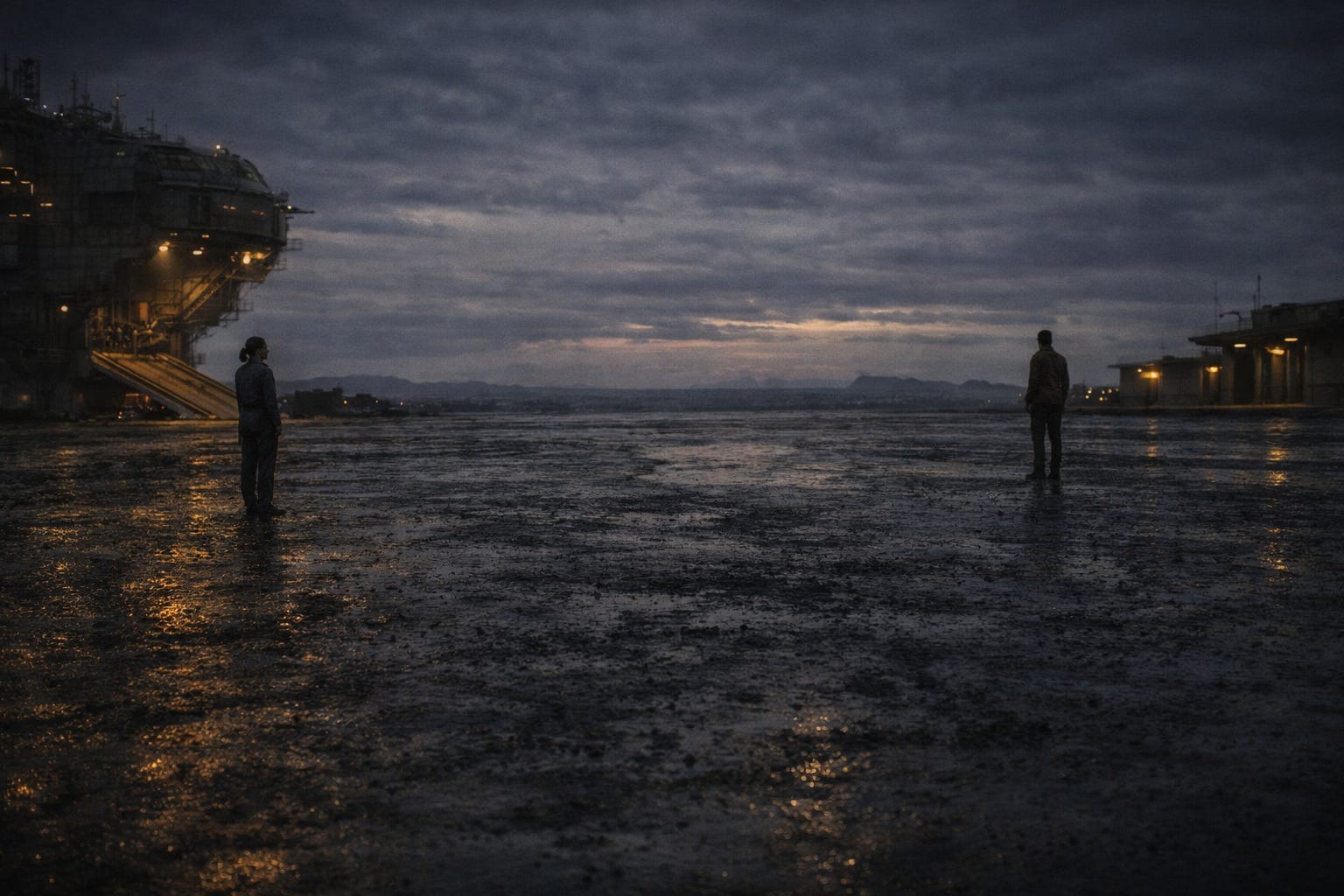
The ramp opened and the air came in.
Not filtered. Not processed. Not the narrow-specification atmosphere of a vessel that had spent three centuries learning to erase every trace of where it had been. This air had weather in it. Moisture, mineral density, the particular weight of a sky that had rained three days ago and was still deciding whether to rain again.
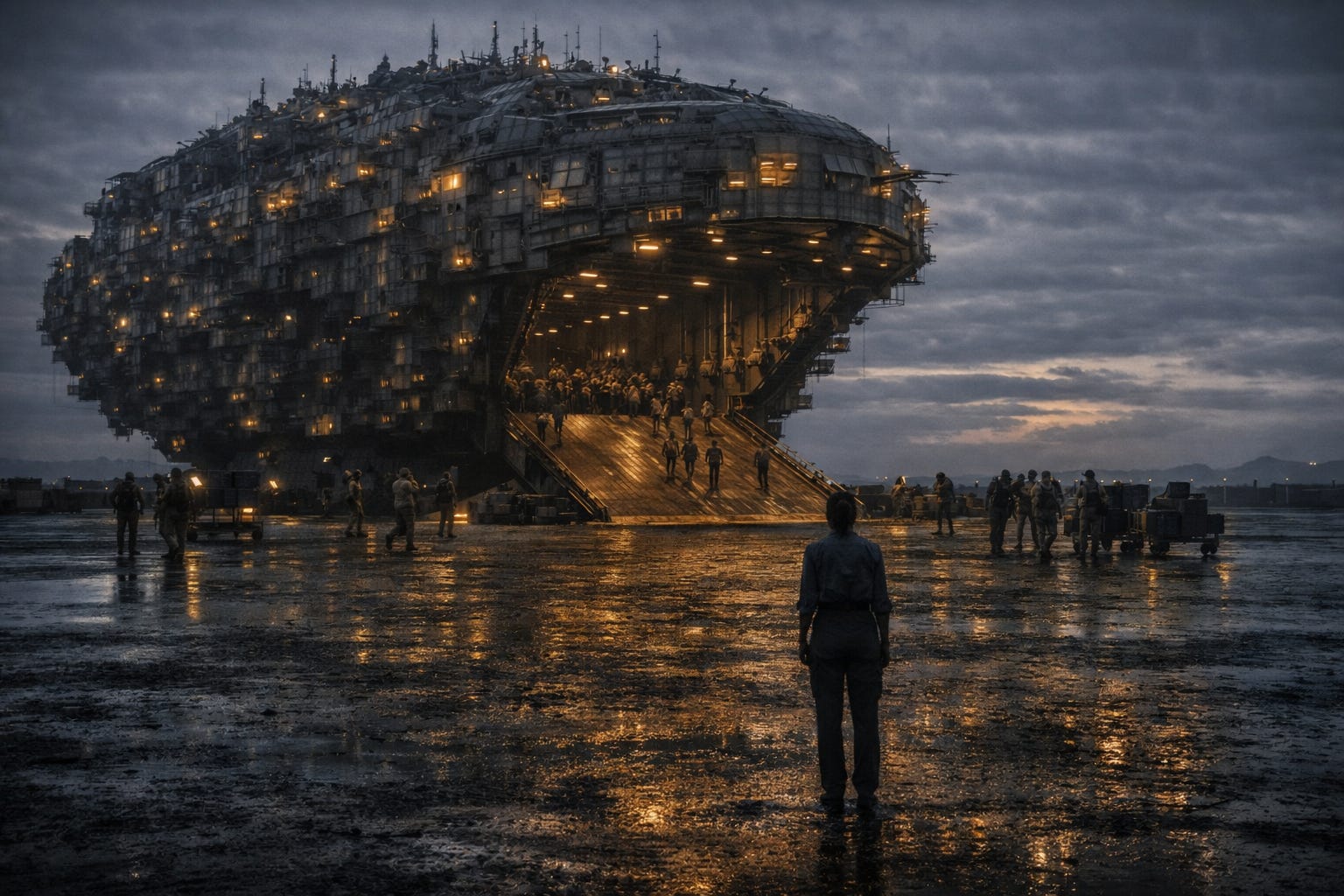
Megil stood at the top of the ramp and did not move.
Below her, Tresil’s landing platform stretched into the dusk — dark ground, wet, holding water longer than ground should. The crew moved past her in the efficient way Chilin crews moved everywhere: purposeful, unhurried, attending to logistics with the focus of people who had done this ten thousand times. Supply crates. Equipment checks. The particular choreography of planetfall that required no thought because thought had been designed out of it three centuries ago.
She was not part of the choreography. Sub-division heads did not have planetfall duties. She had no reason to be on the ramp at all.
She stepped down.
The ground was harder than she expected — compacted, dense, the kind of surface that didn’t give. After eleven months of deck plating, her legs registered the difference before her mind did. Real gravity, not compensated. Real ground, not engineered. Her body understood this before she had words for it.
The wind found her immediately.
It came from the east — across the platform, across whatever was beyond the platform, carrying the temperature of open distance. It moved through her hair, pulling strands loose from where she had pinned them that morning in the narrow light of Deck Seven. She felt them cross her face and did not push them back.
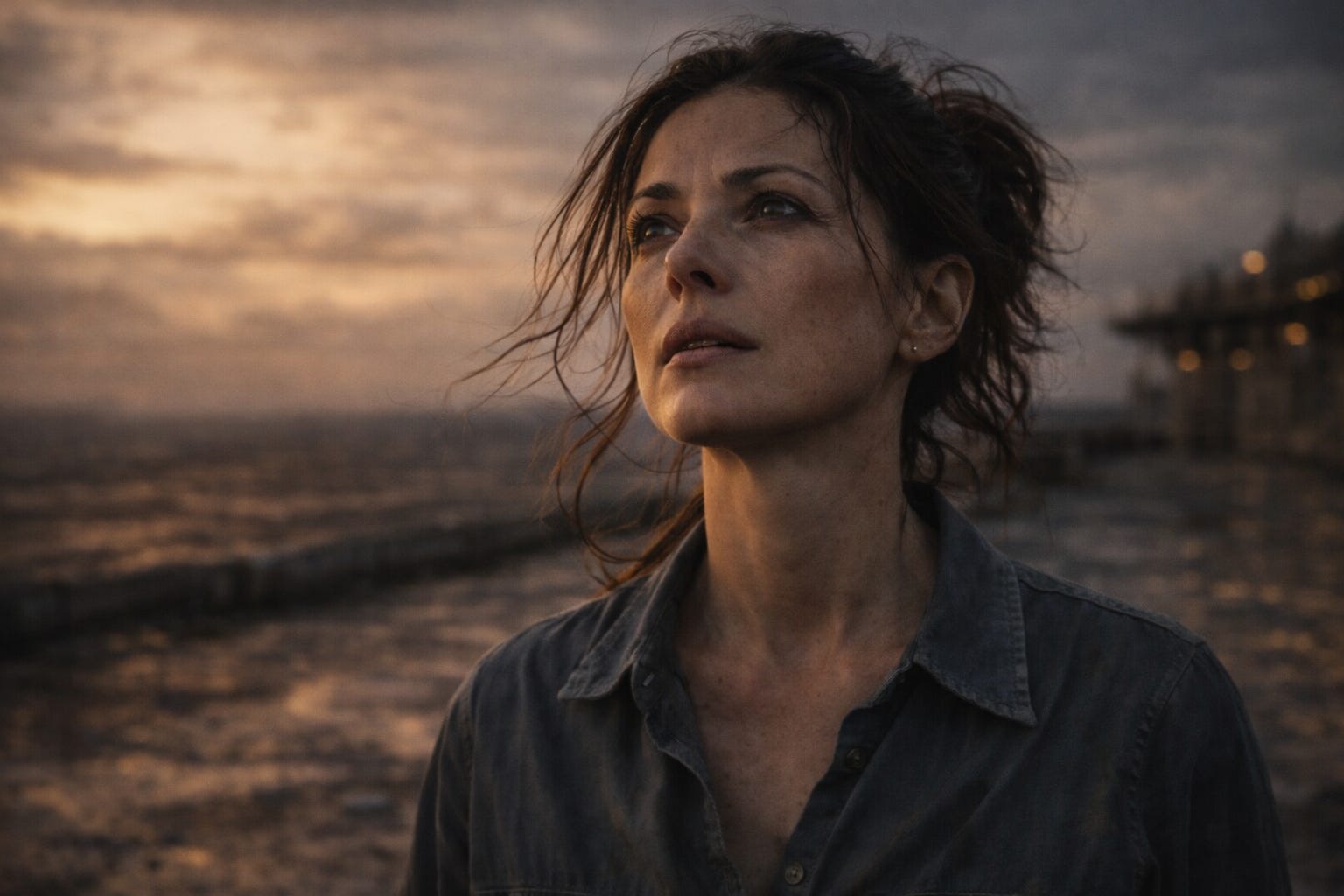
Something released.
Not a decision. Not a thought. Something older and lower — a tension she had been holding so long it had become architecture, and now the architecture was meeting air it had never been designed for. The partition was three hundred meters above her, inside a ship that was already powering down for the night cycle. The terminal with its sharp edge. The queue. The forty-seven projections saved in a maintenance partition no one audited.
All of it was still there. None of it was here.
She stood on the dark ground and breathed air that had already been breathed by a planet, and the question she had not saved — *What does a civilization look like on the other side?* — was still inside her, and for the first time it did not feel like a betrayal of everything she knew. It felt like hunger. The same hunger that had driven her into a borrowed research space eight years ago. The same hunger that had built forty-seven detonation timelines in a single sitting. But pointed somewhere she had never pointed it before.
What surprised her was the rage.
It arrived without warning — not at Loytul, not at Chilin, not at the intake analyst who had stamped moderate value on the end of the world. At herself. Eleven months behind a partition. Eight years of carrying a discovery like a wound instead of a seed. She had built projections of what the singularity would destroy because destruction was the only direction she had ever looked. She had mapped forty-seven endings and not one beginning.
The wind pulled at her hair again. She let it.
She was standing on a planet she had never visited, breathing air she had not chosen, and the rage was clean — not the recursive kind that ate itself, but the kind that clears. The kind that leaves a space where something else can grow.
---
Forid saw her from the eastern edge of the platform.
He had been watching the crew — the way he watched everything, not searching for anything specific, just letting the patterns arrive. Eleven years of this had taught him what most people never learn: that the interesting thing is almost never where you expect it, and the only way to find it is to stop expecting.
The crew moved in formation. Efficient. Coordinated. Chilin-standard — he had seen enough planetfalls to recognize the rhythm without counting the steps. Supply crates, equipment manifests, the particular handshake between ship systems and station systems that confirmed both sides still existed.
She was not part of the formation.
He noticed her the way he noticed the mineral density in the ground, or the way the sky shifted colour before a storm — not because he was looking, but because she was different from what surrounded her. Standing at the base of the ramp while the crew flowed around her. Not lost. Not waiting. Something else.
The wind was moving her hair across her face and she was not fixing it.
That was what held him. Not her stillness — the crew had their own kinds of stillness, the efficient kind, the purposeful kind. Hers was the stillness of someone standing in a current and choosing not to resist it. He had seen that stillness before. In himself, on mornings when the horizon held something he could not name and he stood on this platform and let it arrive.
He did not approach.
Not from hesitation. From recognition. Whatever was happening at the base of that ramp was not his — not yet. The signal was clear, and part of what made it clear was the distance. Eleven years on the edge had taught him that too: some things you receive better from far away. You walk toward them and the frequency changes. You stand still and the signal completes itself.
She turned her face toward the sky. He saw it in profile against the transitional light — angular, sharp, not what he had expected from a Chilin crew member. Not the composed institutional expression he had learned to read and discount. Something unguarded. Something that looked, from forty meters away, like a woman seeing weather for the first time in a long time and being surprised by what it felt like.
He stayed where he was.
The dark ground held the water from the storm. The sky held the last light before evening. The distance between them held something that was not yet a relation and was already more than nothing — a signal, faint, the kind that only carries across open ground where nothing stands between the source and the receiver.
The *Censig* powered down behind her. The outpost hummed its low frequency ahead of him. Between the two, the platform was open and dark and wet, and two people stood on it without knowing what they were standing at the beginning of.
Forid watched the sky finish changing. Then he went inside to check whether the station’s systems had completed the supply handshake.
The work was the same. The evening was not.