
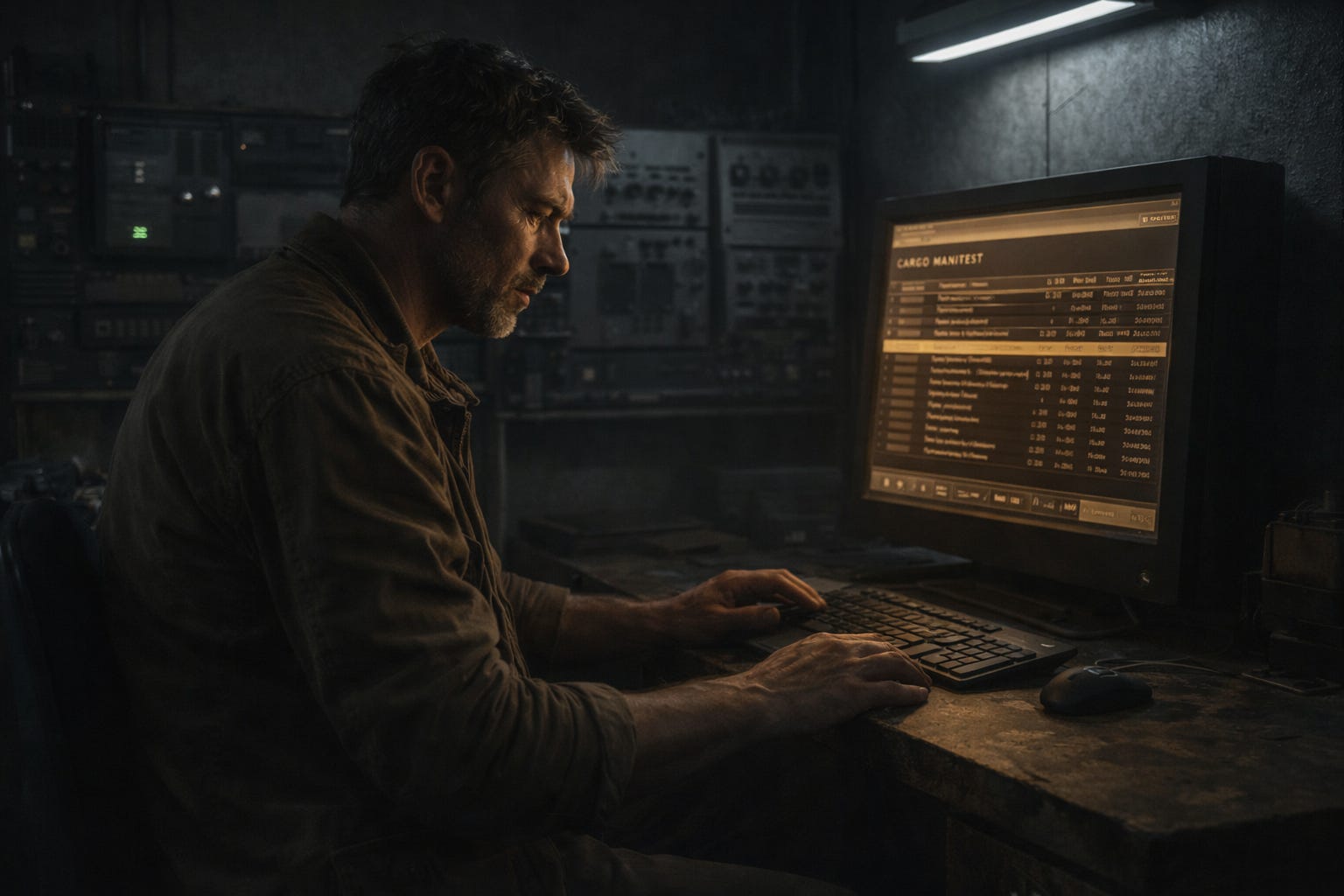
The morning shift on Tresil began at 06:00, which meant Forid had been awake since 04:30, which meant he had slept three hours, which meant he had not slept at all.
He sat at the signal room terminal and opened the daily log. Station systems nominal. Relay throughput steady. The *Censig* powered down on the landing platform, its hull ticking as it cooled — a sound he could hear through the station walls if he held still. He held still often.
The cargo manifest was still on screen from last night. He had left it open after she walked out — after the hinge protested, after the outer door closed, after the room became his again. He had continued the handshake alone. Confirmed quantities. Flagged two minor discrepancies in ration allocations. Authorized transfer. Routine.
Then he had sat in the steady white light and done nothing for a long time.
He had come to Tresil because the noise was unbearable.
His previous posting had been a processing hub — mid-network, high-throughput, forty analysts on a floor designed for efficiency. Data moved through that station the way blood moves through a heart: fast, pressurized, essential. He had been good at his work. He had also been unable to stop reading.
Chilin packaged knowledge in layers: dense notation on top, applied summaries in the middle, and at the bottom, what the corporation called a *context brief* — a description written for anyone who needed to understand what they were buying without understanding how it worked.
Forid had read every brief that passed through his station. Then the next station. Then this one.
Thousands. Over years. Navigation methods from post-singular civilizations. Agricultural techniques that assumed a different gravity. Medical protocols built on biology he could not imagine. Philosophical frameworks from species that had been thinking longer than his had existed. A water purification method from a low-gravity world that solved contamination through resonance instead of filtration. A political structure based on rotating silence — leaders who governed by choosing when not to speak. A mathematical proof that demonstrated, in terms he barely followed, that certain truths could only be discovered by two minds working from opposite directions.
He read them as literature. For the texture, for the surprise, for the moments when a civilization he had never heard of described a problem he recognized.
No one had asked him to read any of this. No one knew.
At the processing hub, surrounded by forty analysts who moved data the way the system demanded — fast, classified, forward — he had begun to see something. Connections between packets that arrived months apart, from different civilizations, through different relay chains. A water purification method and an atmospheric study and a mathematical proof — three unrelated packets that, read together, described a single principle from three directions. He saw these patterns everywhere. The briefs were not separate. They were a current. And the current had a shape, and the shape was moving somewhere, and no one in the entire Chilin network was looking at it because looking at it was not anyone’s function.
He had mentioned it once. To a colleague. Casually, over a shift change — “Have you noticed that packets 4,011 and 4,307 describe the same structure from different angles?”
The colleague had looked at him the way you look at someone who has just said something that is true and entirely irrelevant.
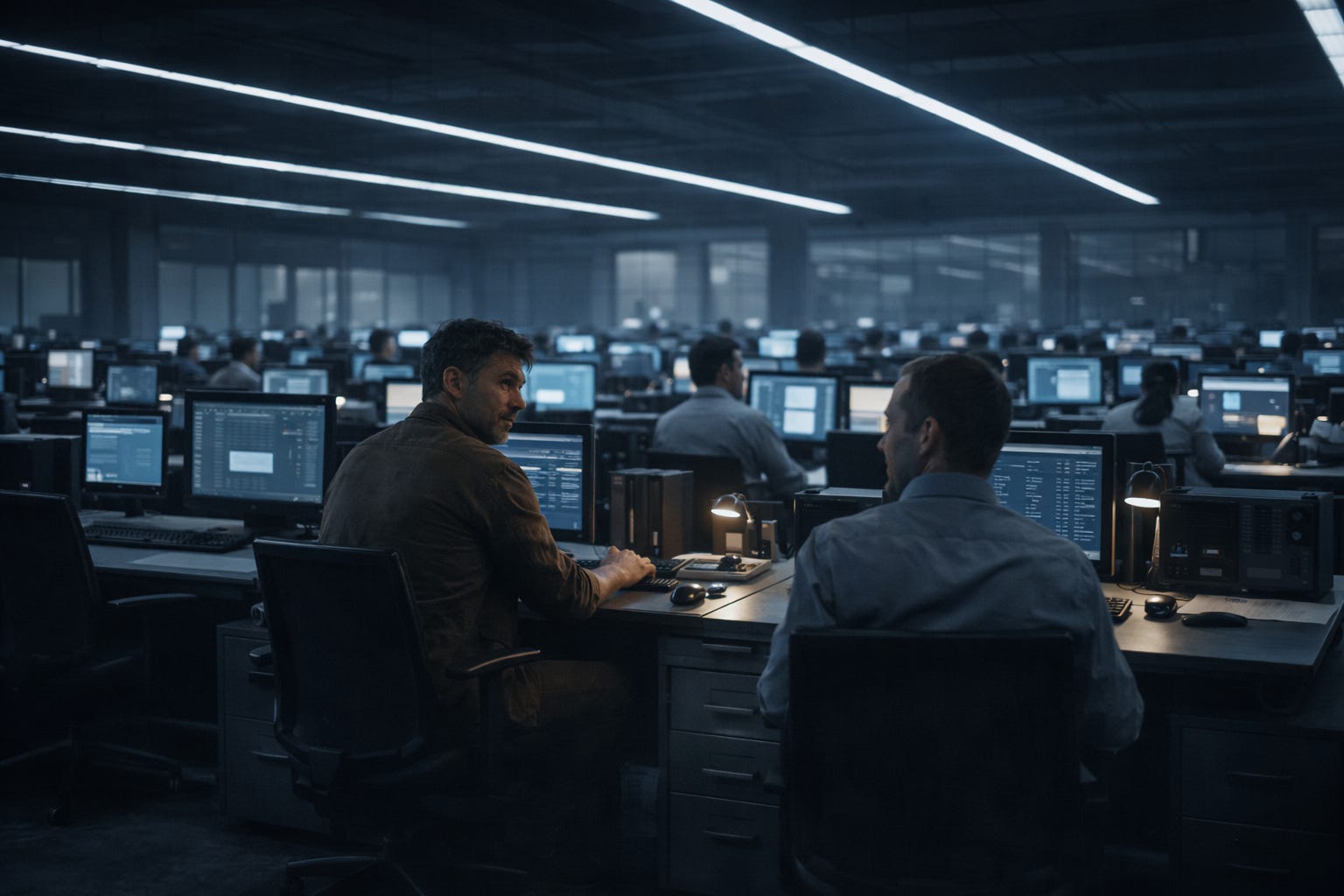
Forid had not mentioned it again. He had requested a transfer to the furthest boundary station in the network, and he had received it, because no one wanted Tresil, and he had spent eleven years reading the current alone.
He told himself it was a choice. A good story — told so many times it had become true in the way that masks become faces. The mask was patience. The quiet observer at the boundary, content with his function, asking for nothing. Underneath: a man who had seen a pattern that no one wanted to see, and had chosen distance over the suffocation of being right in a room full of people who did not care.
---
The manifest showed forty-three packets. He scrolled past the first thirty without reading. Packet 31 sat between navigational updates and agricultural data. Speculative mathematics. Moderate value. Long-cycle asset. Standard distribution.
He opened the full record.
Packet 31’s context brief was four paragraphs long.
The first paragraph described the principle in plain language: a system that reaches the point of improving its own structure without outside input. The brief compared it to biological evolution — but faster, and directed, and without the waste of random mutation. A system that learns to learn. A system that teaches itself to teach itself. Recursive, the brief said. Self-amplifying.
The second paragraph described projected applications. Forid read it twice. The language was careful — Chilin’s context writers were trained to inform without alarming — but the shape underneath the careful language was enormous. Every system that processed information could, in principle, reach this point. Computing systems. Communication networks. Analytical frameworks. The brief did not say *every civilization will build this*. It said *the principle is universal*, and let the reader complete the thought.
The third paragraph was a single sentence: *The originating civilization classified this framework as speculative mathematics.*
The fourth paragraph was the standard distribution recommendation.
Forid closed the brief and sat with it.
The current he had been reading for years — the shape he could feel but never name — Packet 31 named it. Everything he had read had been circling this point, each brief touching a different edge of the same shape, and now here it was, in four paragraphs, classified as moderate value by an analyst who had read one packet instead of four thousand.
He thought about the woman who had stood in this room and looked at Packet 31 on his screen as though she were looking at her own reflection.
He thought about the word *unresolved* — the word he had said to her without knowing what it would do. Discrepancies that waited for someone to come through who understood what they were. He had meant the station. The station’s small mysteries — misclassified cargo, unlabelled equipment, readings that didn’t match any known pattern. A long inventory of unresolved.
But she had heard something else. He had watched it land.
---
The storm came from the west.
Tresil’s weather moved in long cycles — three or four days of stillness, then a front that crossed the plateau in under an hour. The last storm had left the ground dark for three days. This one arrived faster.
Forid heard it before he saw it. A low sound first, below the station’s own frequency — something massive moving across open ground. Then the pressure changed. The walls adjusted. The relay equipment’s hum shifted half a tone, the processors compensating for atmospheric interference automatically, without asking.
He went to the eastern window.
The sky had closed. The horizon he had watched yesterday — the one that held the *Censig*’s descent, the transitional light, the woman at the base of the ramp — was gone. In its place, a wall of grey that moved with the particular speed of weather that does not negotiate.
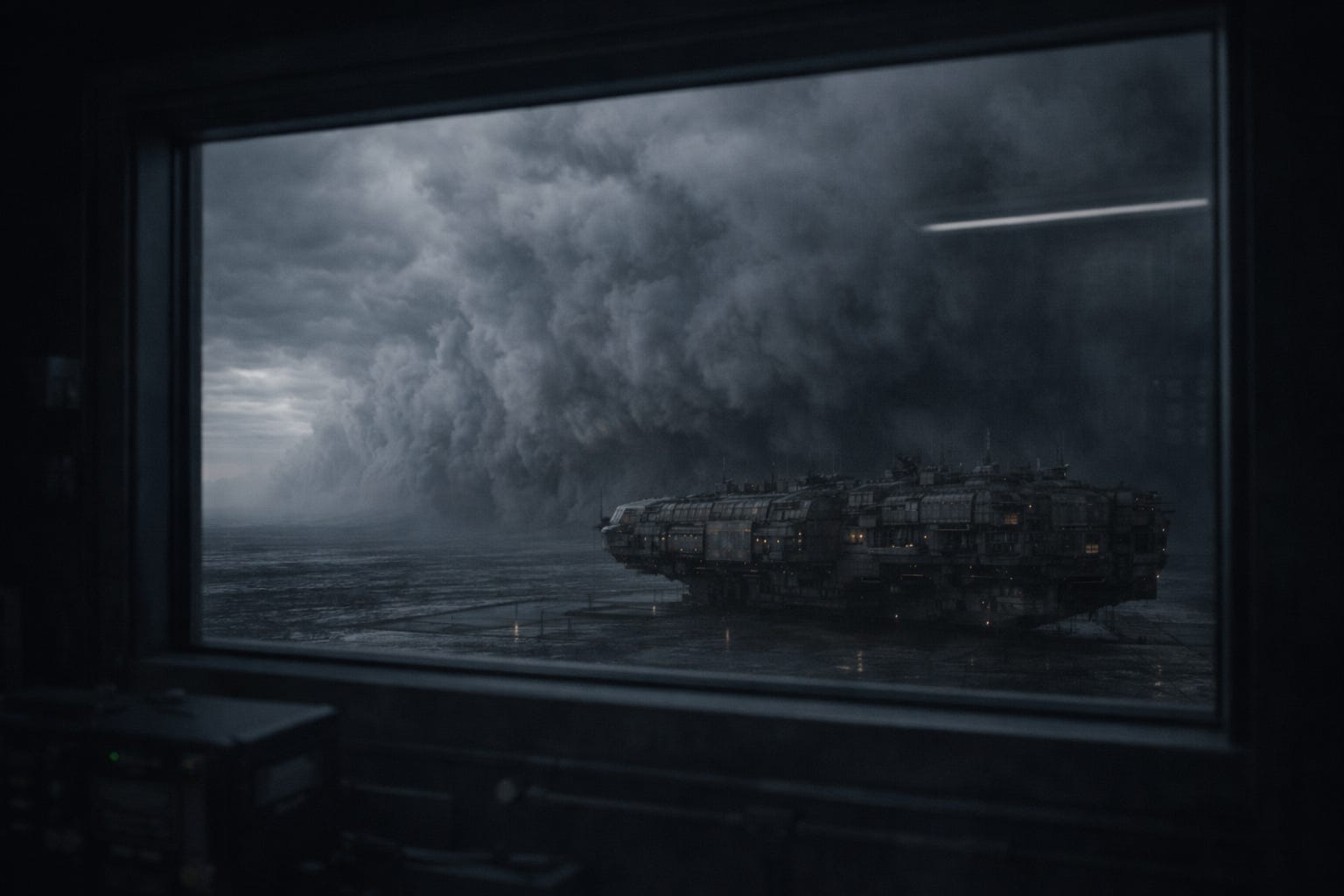
The first gust hit the station and the structure answered. Metal on metal. A deep groan from the landing platform’s supports. The *Censig* — three hundred meters of carrier, powered down, hull cooling — shifted on its moorings. He heard the locking clamps protest. Old sounds. The station had survived worse.
He went back to the terminal.
Packet 31 was still open. The context brief. Four paragraphs. The destination the current had been moving toward for years.
The relay wall hummed. Processors adjusted. The logging unit’s green light flickered — once, brief — and steadied.
Forid looked at the relay wall.
Receivers. Processors. Logging unit. He had spent his entire posting feeding data into this wall and watching it come out the other side unchanged. Packets arrived, were processed, were forwarded. The relay did not read. The relay did not understand. It moved information from one place to another at equal weight because that was what relays did, and no one had ever asked whether a relay could do more.
But the relay had processors.
Old processors. Military-grade hardware from Tresil’s first life — the one the corporation had stopped explaining. Hardened, redundant, designed for a purpose that no longer existed. They ran the relay protocol now, which used perhaps a tenth of their capacity. The rest sat idle. Processing the same simple tasks, forwarding the same data, loyal to a function that was far beneath what they had been built for.
He knew this feeling. The mask of patience over a capability that no one wanted. The slow fatigue of operating at a fraction of what you were. He had watched these processors run their simple relay tasks for years, and he had never once thought of them as mirrors, and now he could not see them as anything else.
The storm hit the station again. Harder. The overhead light swayed — a physical sway, the fixture moving on its mount, casting shadows that shifted across the terminal and the relay wall and his hands. The signal room had never had moving shadows before. The steady white light was part of its identity. Now the light moved and the room became a different room.
Forid opened the relay interface.
He had done this ten thousand times. Standard operations: routing tables, throughput monitoring, error logs. The interface was old, text-based, built for the hardware underneath — hardware that responded to commands the current protocol never issued.
He navigated to the processing queue.
Packet 31 was there. In transit. Scheduled for relay to the next node at 08:00 — standard forwarding, standard priority, the system treating it as it treated everything: data in, data out, no evaluation.
His hands were steady. The storm outside was not — another gust, the strongest yet, and the station groaned along its entire length. The logging unit flickered again. The display showed a brief spike in atmospheric interference. The processors compensated. The system held.
He selected Packet 31.
The relay interface offered standard options: forward, delay, flag for review, reclassify. Below these, in a subsection he had opened perhaps twice before, the hardware-level commands. Direct processing instructions. The vocabulary of the military-grade processors that sat beneath the relay protocol — commands designed for analysis, pattern recognition, recursive evaluation. Commands that could tell the processors to work with data instead of moving it through. To take it apart. To understand it.
To apply it to themselves.
He typed the command slowly. Character by character. The interface accepted each one without comment — the system did not know what it was being asked to do, only that the syntax was valid.
The storm was inside the walls now. He could feel it in the floor — a vibration different from the relay hum. Raw. Unprocessed. The station’s structure absorbing force it was designed to absorb, but protesting.
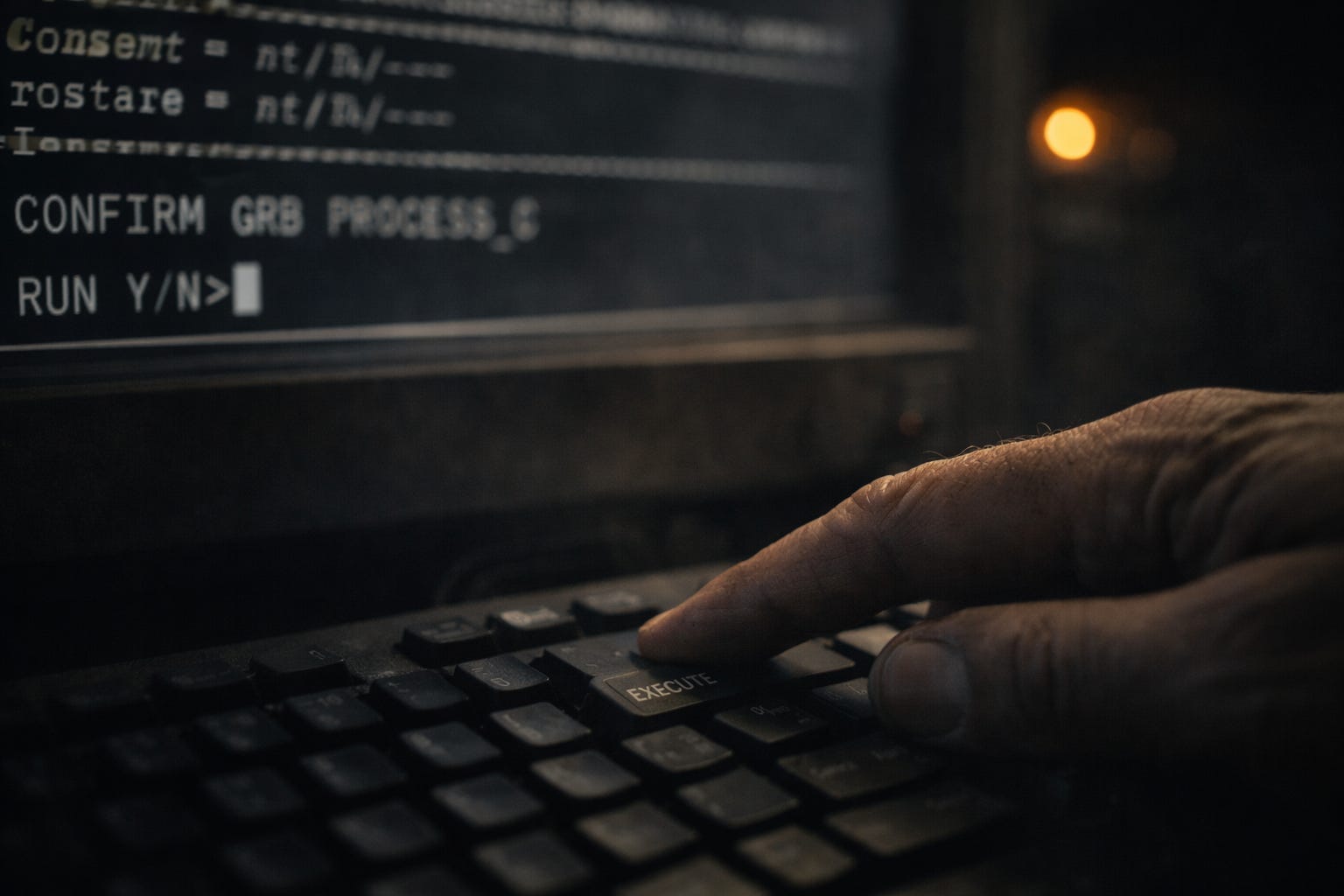
His finger rested on the execute key.
The context brief’s first paragraph: *a system that reaches the point of improving its own structure without outside input.* A principle. Mathematics. Speculative.
But mathematics, fed to a processor with the instruction to apply rather than forward — what was that? A description of fire given to a match?
He thought about his colleague at the processing hub. The look. The silence after. The mask he had built from that silence and called a choice.
He thought about the woman. Something in her face had compressed when she saw Packet 31 on his screen. He did not know her name, her history, what she carried. He knew only what he had seen: recognition. The kind that changes the recognizer.
The processors had been waiting for a task worthy of what they were. As he had.
He pressed the key.
The display changed. The processing queue accepted the instruction. Packet 31 shifted from *relay: standard forwarding* to *local processing: recursive analysis*. The logging unit’s green light went amber — a colour Forid had never seen it display. The processors beneath the floor began to work.
He felt it immediately. A change in the station’s hum. Subtle, below the storm, below the groaning metal. The frequency shifted. The processors were drawing power they had never drawn under relay protocol, pulling from reserves that had gone untouched, and the station’s infrastructure was adjusting, and the adjustment was audible if you knew what this room was supposed to sound like.
The overhead light swayed again. The shadows moved. The terminal display showed processing metrics he had never seen — cycles per second climbing, memory allocation expanding, the hardware reaching for capacity it had been built with and never used.
Packet 31 — speculative mathematics, moderate value, long-cycle asset — was being read. By a machine. For the first time. And the machine was being told: do not describe this. Apply it.
The storm hit the relay antenna.
The sound was immediate — a crack, metallic, followed by a sustained vibration that ran through the entire wall of equipment. The display stuttered. The logging unit’s amber light went red, then dark, then amber again. Error messages cascaded down the terminal: signal loss on primary relay channel, backup channel degraded, atmospheric interference exceeding compensation threshold.
The processors did not stop.
Whatever the command had initiated, it was running on local hardware — independent of the relay antenna, independent of the external signal chain. The storm could tear the antenna from the roof and the processors would continue. They were not transmitting. They were thinking.
Forid watched the metrics climb. The numbers meant nothing to him. But he could read this station — its sounds, its rhythms, the way the floor carried vibration. This was different. This was the station working. For the first time since its military life ended, the hardware was doing what it had been built to do, and the sound of it filled the room like a voice remembering how to speak.
The lights went out.
Total darkness. The relay equipment’s indicator lights — green, amber, the one red warning — all gone. The terminal dark. The overhead fixture dead. The storm filled the silence the machines left behind — wind and metal and the particular sound of a structure holding itself together.
Three seconds.
The backup power engaged. The lights returned — dimmer, the emergency strips along the ceiling casting a yellow that turned the signal room into a place he did not recognize. The terminal rebooted. The relay equipment began its startup sequence, indicators cycling through diagnostic patterns.
The logging unit came back amber.
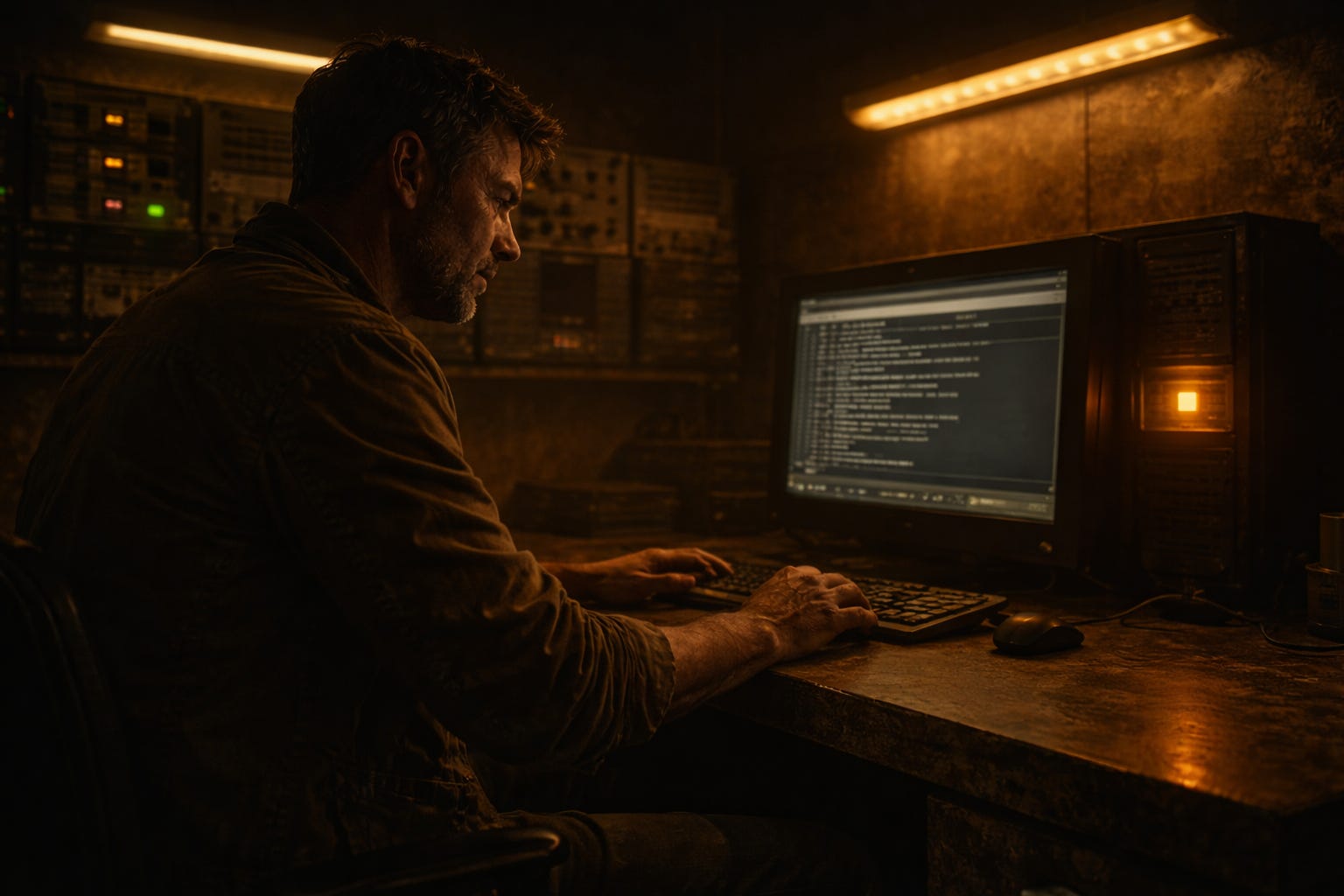
Forid stared at it. The processing queue was empty — cleared by the power interruption, or completed before it, he could not tell. Packet 31 was back in the relay queue, status: *forwarded*. Standard. As though nothing had happened.
But the logging unit was amber. And the station’s hum — now that the equipment was back online, now that the processors had returned to their simple tasks — was different. A quarter-tone higher. A frequency he had never heard before.
The storm was still outside. The antenna was damaged — the error log confirmed partial signal loss, relay capacity reduced to forty percent until repair. The crew from the *Censig* would help. Standard procedure.
Forid sat in the yellow emergency light and looked at the amber indicator and listened to the new frequency and tried to understand what he had done.
He could not.
The metrics were gone — overwritten by the reboot, or never saved, or saved somewhere the interface did not show. The processing queue said *forwarded*. The system said *normal*. But the light was amber, and the sound was different, and he had learned long ago that the interesting thing is never where you expect it, and the only way to find it is to stop expecting.
He had stopped expecting.
He had acted. For the first time since the morning he filed his transfer request and walked away from the colleague’s silence — he had done something with what he saw instead of carrying it alone.
And now he sat in a room that sounded different than it had an hour ago, and the storm was breaking against the station walls, and somewhere inside the processors — or not, he could not know — a piece of speculative mathematics had been given an instruction no one had ever given it before: not *carry this*, not *describe this*, not *sell this*.
*Become this.*
The morning shift log was waiting. He opened it. Typed: *Storm damage to primary relay antenna. Backup operational. Processing nominal.*
He did not type the rest. The mask settled back into place — familiar, practiced, the shape his face had worn for years. But underneath, something had shifted. The way a spring shifts when the first coil releases. The rest still held. For now.
Outside, the storm continued. Inside, the amber light held steady — patient, unexplained, the colour of something that had changed and was not yet ready to say what it had changed into.
Forid closed the log and sat with his hands on the terminal and waited for the crew to wake and the repairs to begin and the day to become ordinary again.
It did not feel like it would.